Losing My Maps
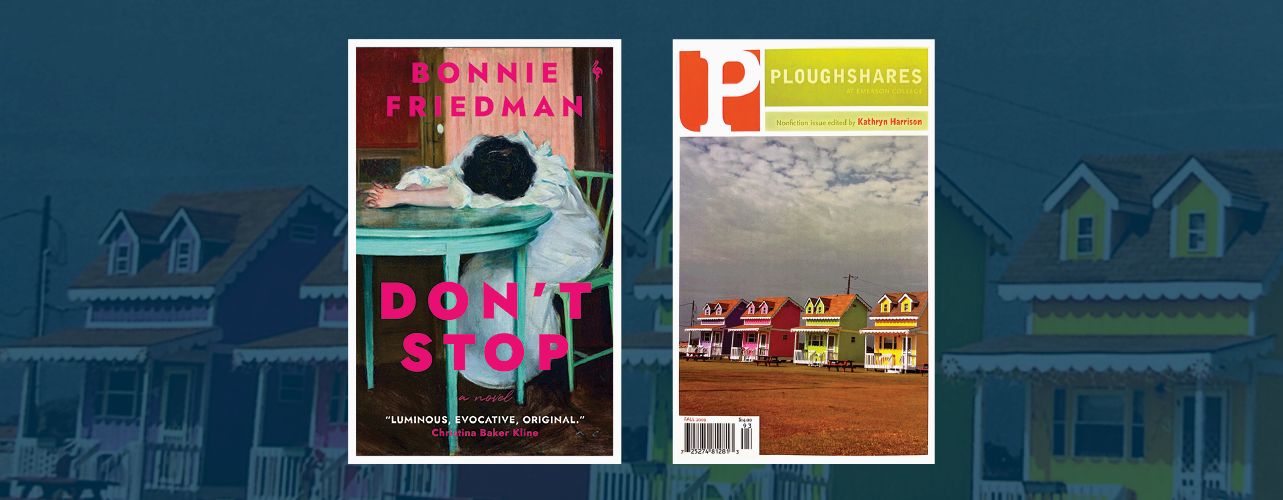
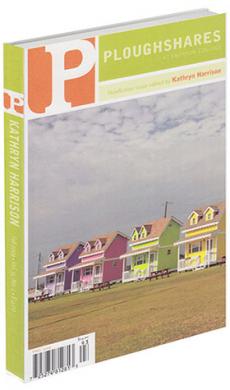
“You are too nice,” Kathryn Harrison once said to me. Or perhaps what she said was, “You are very nice!” but to me it sounded like the same thing. I admired and admire Kathryn. She is an astonishing writer and an astonishing soul. Several years ago, she guest-edited an issue of Ploughshares, and she devoted it entirely to the personal essay. No fiction, no poetry. She framed her intro to all this nonfiction with two images, both startling. As young parents, Harrison and her husband purposely entered a riptide. They were carried along about 500 yards, then fought their way out onto the beach and ran back to where they started. Then they entered the riptide again, over and over, so the surge could carry them. The second image was of the same couple 18 years later, shortly before that issue of Ploughshares went to print. Now the couple is on an ocean liner’s windswept deck, although the captain had asked all passengers to stay inside. They are playing paddle tennis. Gusts snatch the ball occasionally, but fortunately, there is a webwork around the court. Still, Harrison’s husband is “Drilling balls to my weak backhand and running me over every inch of my side of the net.”
What do these images have to do with the personal essay? Why invoke them? After all, for some of us the essay is a probing form. With a method like a pathologist’s. In fact, Kathryn herself uses the term “vivisect” to describe its process. It is the opposite of the erratic. We set before ourselves an imperfectly understood experience, something we sense we might grasp if we deploy the tools of the genre – scene, reflection, association, language that transmutes events in much the same way that, when we put words to a dream, we sometimes instantly (and horrifyingly) hear its meaning. For me, the personal essay has been a necessary form. Without it, much that I have lived would be only blurrily understood. The essay pulls the seeping figures into focus. Sometimes I think of it as offering a lens that resolves haunting shapes; other times I think of it as a prosthetic arm that lets you extend your reach. But this involves careful work. One is assessing, testing, attempting, as the very term “essay” suggests.
Rule-breaking in some circumstances is wiser than obedience.
So what does this have to do with surrendering to a surge and taking mad risks? Harrison says that, in choosing these images, she was regarding the course of her own life, a writer’s life, and that the two scenes were bookends to all the years of living and writing, and child rearing, that came in between. Now that the eldest child is off to college, Kathryn’s considering the passage of time. But I think there’s more to it. I hear her again suggesting something about the possibility of being too nice. She is talking about bravado, isn’t she, a trait some essayists and many excellent contemporary memoirists display. James Baldwin said that he admired Dickens’ bravado, and one doesn’t have to look far to see in his own work the bold claim, the stark generalization, the prophet’s galvanizing testimony. In his great essays, Baldwin does seem to be riding a current, the language rushing, transporting, and channeling the magisterial power of his father’s church and his own boyhood preacher’s fire and eloquence, allowing himself to be swept up, allowing himself to be gathered and humbled and swept.
Harrison too had a father who was a divine, although in childhood he was an absent one (and later yet a pernicious one), and she too had to find her own way, without reliable parental guidance. I think this accounts for a certain confidence in her work, a certain bone-deep self-reliance. If she were going to survive, she would have to do so on her own. And in fact, taking risks might have actually seemed safer than rule-abiding; it made her experience her own strength. Authority was flawed, hypocritical, sanctimonious, evasive. Raised by grandparents, with an extremely young mother unequipped to meet the needs of a child, she was to some extent, it seems to me, obliged to raise herself.
For comparison’s sake, I will explain that my own way was more tentative. My parents were far older than my friends’ parents; they had married late. I saw their frailty. I was afraid for rather than of them. I bolstered rather than challenged them. And this marked my writing, naturally. I took careful soundings. I trained my ears to hear the overtones and undertones at a friend’s old New England family’s dinner table and in what I read. I discovered the power of le mot juste. Finely tuned writing allowed me to make sense of experience. I did not hurry. I could not. Rushed, my work degraded. I was leery of those who self-mythologize, and disappointed by audiences who trusted that self-aggrandizement. Couldn’t they see the element of fraud? The roar of the motorcycle, the bleed of the black eyeliner: in a writer’s work they seemed to impose rather than discern a true meaning. I mistrusted the performative.
“You are too nice,” said Kathryn to me. By that point in my life, my early forties, I’d learned respect for the riptide because one had broken my nose. I’d been up to my knees in paradisaically glassy water when I was yanked by the ankles and deposited on my face. Saltwater scraped my throat and I was pulled far out and down, engulfed. Yellowish green water swirled around me. I desperately needed to breathe. All was equally illuminated. Which way to swim to get a breath? I did not know which direction was up. I knew I might drown. And then, somehow, I was pitched out and crawling onto the beach, shocked, shouting. The next morning, the mirror displayed a cubist face, aspects unaligned. But it wasn’t until three weeks later, back in New York, when a doctor told me my nose was broken, that I credited what I’d seen in the hotel glass.
So: my own experience of reality required vigilance. You might be clobbered at any point. In my childhood, parents were sweet people who needed one’s help. My mother was enormously shy, my father employed by people he seemed to overly respect. Reality itself actually had a swirling, disorienting, dangerous quality. We lived with packing boxes behind the furniture because we might need to move again. The grownups could scarcely manage. I couldn’t imagine attacking them, thwarting them. What selfish, self-indulgent behavior! I was that high school girl, arm around my mother’s waist, holding my mother’s hand, going to Weight Watchers with her, getting more slender by the week, the cardboard belt cinched ever tighter, gathering the diamond chips that meant I’d lost another ten pounds, cheerfully and triumphantly entering anorexia, feeling for the first time ever pride in my achievement, discovering the power of discipline.
And ultimately, in the plunge into the imagination, I found the truths that nonfiction didn’t grant me.
Would it be wrong to say there are two ways ahead, the rebels’ and the good girls’, the Lilas’ and the Lenus’ – to use Ferrante’s famous characters – and that the Lenus are secret Lilas? At a certain point in my own obedient life, I, a studious Lenu, became a Lila. A riptide of sexuality carried me. I seemed to have no volition in the matter. My body wanted the current, my mind wanted the current, other parts of me that have no names begged for it. I could not stop even when I risked disaster. And afterwards I needed to find a way to write the experience. I didn’t know what had happened, really. I didn’t know which way was up. The thing that had happened to me was all over me. It was a human-sized pleasurable jellyfish with suckers stuck to me. It was deep in my dreams. To see it, I needed to achieve some distance. Memoir didn’t afford this. I needed fiction. I needed a character who wasn’t me and a situation not my own. And so I had to learn how to write a novel. And ultimately, in the plunge into the imagination, I found the truths that nonfiction didn’t grant me. When I emerged, when I crawled out, disoriented, panting, grit under my knees and palms, a decade had passed, and I’d discovered that in fact the risk-enamored self isn’t contrived, isn’t just performative. Dionysius too bestows truths.
There is a point in many stories when the characters have to lose their maps. They need to get lost. They don’t know up from down. The old meanings have floated off like soaked decals; the old pieties no longer make sense. In my own life, I’d experienced a time when my judicious method couldn’t help me, and so I abandoned it. I ignored the good, sane advice of my best friend. I did things I couldn’t justify. The riptide took me, and in its swirling rush I heard voices. There were parts of me I’d sacrificed without knowing it. And they had grabbed me by the ankles and dragged me out to sea. When I emerged, I was no longer exactly who I’d been. People told me I had more authority.
Now, in retrospect, I see why it makes sense to frame nonfiction with windstorms and tide-riding. I hadn’t understood before. Raising children, writing, life itself is bounded by risk. Rule-breaking in some circumstances is wiser than obedience. And an essay can use a strong persona who can wade out into it and withstand its stresses, all the wild turns. By some nice symmetry, it’s been 18 years since the publication of the Ploughshares issue Harrison edited, twice that since she was a young parent entering the coursing sea. She accurately judged at that time that she could emerge, and she never let herself get too far. She suggested that the defiant, grandly forthright way is also an option. Bravado, to use Baldwin’s term. The way she told it, boldness emblematized her method from the time when her children were young to when they left for college. She gave me an example to resist and then, finally, to celebrate when my own life taught me the truth about learning to ride the current, which might overwhelm you when you least expect it, and the dangers of trying to stay too safe.