Recovery as Resistance: Rolando Cárdenas, Shreela Ray, and Peter Huchel
Ploughshares is excited to announce our new partnership with The Unsung Masters Series. The Unsung Masters Series, supported by The University of Houston, Gulf Coast, Copper Nickel, and Pleiades, publishes and distributes one book a year that showcases an important writer who has been unjustly neglected and/or whose work is currently out of print. Each volume combines a generous selection of creative work with rigorous critical response from contemporary writers and critics. This series aligns with our mission to celebrate emerging and established writers through our print journal and newly launched PS, an online series of new work in conversation with our 55-year archive.
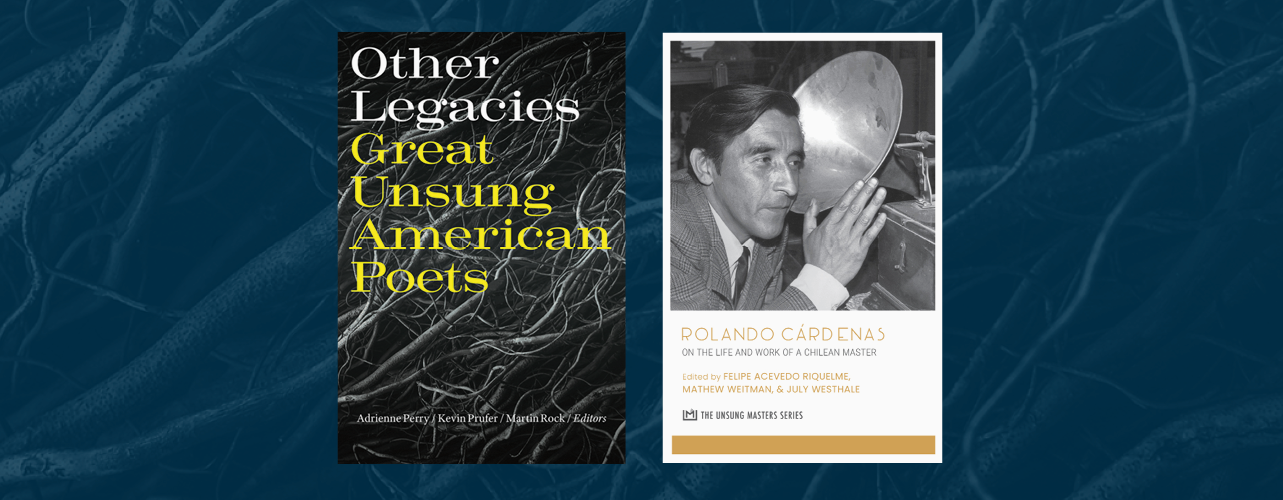
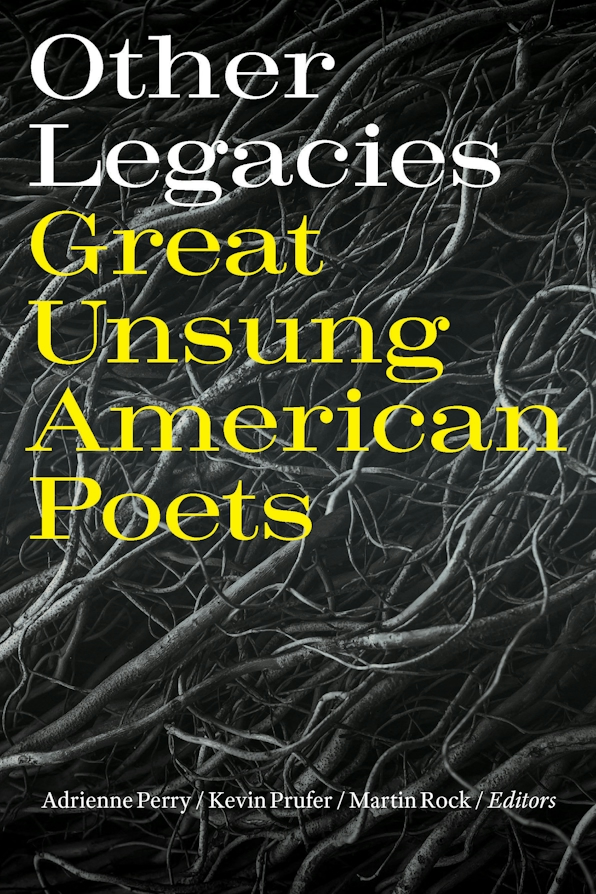
In this PS essay, Martin Rock, poet, translator, and Co-Director of The Unsung Masters Series, considers the archive as a living site of resistance, where poets like Rolando Cárdenas, Shreela Ray, and Peter Huchel reframe erasure, authoritarianism, and the distortions of the present moment through a sharpened historical lens. Rock is also the Co-Editor, along with Kevin Prufer and Adrienne Perry, of the forthcoming anthology Other Legacies: Great Unsung American Poets. This new anthology from Wesleyan University Press offers an alternative story of American literature with thirty-five extraordinary but under-recognized poets whose work has shaped and enriched the literary landscape of the twentieth and twenty-first centuries, writers whose contributions were overlooked because of race, gender, sexuality, disability, region, language, resistance to prevailing literary norms, or plain bad luck.
“To be in the margin is to be part of the whole but outside the main body.
[It is] a site of radical possibility, a space of resistance.” —bell hooks, “Choosing the Margin as a Space of Radical Openness”
When future historians access the archives, may no account of this moment ignore its encroaching tyranny. Archivists are essential to memory: they prepare artifacts to be recovered, sometimes by reformatting (as with digital archives), and sometimes by physically re-covering (as with a book or magazine). To recover is to reclaim, to protect again; to recontextualize or reform; at times, to resist. The archive enables the past to press its shape against the present (striking, how against contains again). Occasionally, as with this PS series, an exploration of the archive becomes an entry into the archive. Literary archives, in particular, carry marginal perspectives on historical events, so they can offer us models of resistance. With all this in mind, I’m reading past issues of Ploughshares through two lenses: first, to discover and share voices who are new to me, or who I believe deserve much greater readership. And second, I’m seeking work that might help us unravel and unmask fascism, in the spirit of recovering important models for resistance today.
This unmasking is not a metaphor. In the last year, masked federal agents have shot and killed American citizens in American streets, funded by American tax dollars. Calling this “immigration policy” is an Orwellian inversion of terms; it is a policy of exclusion, expulsion, and eradication, intended to suppress voters and break American democracy. Even as the news cycle shifts from one international atrocity to the next, masked federal agents remain on American streets, and now in American airports. They are still attacking, brutalizing, and disappearing the parents of American children from American neighborhoods. In February, masked men abducted a five-year-old child in a bunny hat to use as “bait” in hopes of drawing out his family members from their American home. I emphasize the “Americanness” of the families and neighborhoods being subjected to this violence, as though this is a value that can be easily quantified or measured. This word has always been a negotiation around not only who is invited into the project of American democracy, but also who is excluded from it, and who is oppressed, ignored, or disappeared by it. Interestingly, this negotiation has also always been part of the project of American literary magazines and their archives.
Just as swiftly as these violent images become pervasive, they are absorbed into the ever-shifting news cycle, a familiar strategy designed to reshape and distort memory; to erase even our ability to remember. In the same way that fascism requires an infrastructure of attention that can transmute violence into spectacle, the attention economy requires images that will arrest our increasingly frayed and fracked attention, such that our awareness can be transmuted into shareholder value. The more an image elicits emotional response, the further it reaches; thus the algorithm learns what holds our attention, and thus it shapes our attention to be held. In times like these, the archives, and especially marginal archives such as those that contain and engage literary works, are ever more necessary to prevent further erasure, erosion, and distortion.
In this way, archives do not only record the moment for posterity, they give us the tools to retain ownership over our own minds. They teach us to understand language not as something immediate and fleeting, but as material that might extend and exist even across civilizations. The archive is a necessary tool for memory, just as memory is a necessary tool for resistance. So even as I’ve been invited to contribute to PS in celebration of a new partnership between Ploughshares and The Unsung Masters Series, which I co-direct with poets Kevin Prufer and Wayne Miller, I want to also extend profound gratitude to the keepers of archives and to the creators of the work therein. In my own exploration of literary recovery, I hope to seek communion with and to acknowledge those who commit their time to the renewal of lost or forgotten works hiding in the archives: Lost & Found: The CUNY Poetics Document Initiative, Ugly Duckling Presse, Nightboat Books, Arte Publico, World Poetry Books, and so many more, including the many contributors and editors to Other Legacies: Great Unsung American Poets and The Unsung Masters Series.
The images of racial violence that populate our social media feeds exist in the context of the archives as well: they evoke, but do not equal, Jim Crow lynching postcards, the “scourged back” photograph shared by abolitionists, paintings and drawings of the murder of Jane McCrae used to justify the genocide of Native Americans, the Pulitzer-winning “Terror of War” photograph, and so many other examples of the genre. In each instance, the image of racial violence serves to reinforce the existing stance of the viewer, regardless of their opinions on white supremacy, slavery, manifest destiny, the Vietnam War, etc. We can look to the archives, again, to understand how the technology and scale of distribution have progressed while the mechanism has remained the same. Violence, especially against people of color, is fetishized by liberals and conservatives alike. Whether in horror or in exhilaration, Americans cannot look away. We see this, too, in the flattening of cities and bombing of hospitals and elementary schools in countries we are taught to loathe for their difference. In our feeds, the same images are shared; but the music and the captions are different.
And yet, to constrict American identity to a legal definition around citizenship also denies our history as a country of immigrants. This permeability of boundaries and intersectionality of American identity has everything to do with the archives. I should add here, too, that only Americans from the United States believe this word should apply only to us, and not to all people living in the Americas. The word “American” itself, outside the context of our borders, enforces the same linguistic imperialism that our current moment of fascism perpetuates. The margins are important here: the marginalized, but also the space in which we engage critically with what bell hooks calls “the main body.” Where one body ends and another begins; the space in which we are all, also, part of the whole. This, too, is embedded in the archives: who gets to belong. Who is called American? Who gets to be acknowledged and remembered and protected? What narratives are shaped by what voices from what version of the past? And perhaps most significantly, who gets to live? Who deserves the freedom to remember?
These questions, and sometimes our inability to ask them, inform how archives are produced, but they are also the questions asked by those of us who do literary recovery work. Since 2010, The Unsung Masters Series has been recovering important but overlooked authors with an annual volume of selected work, edited and contextualized by contemporary writers and critics. Like Ploughshares, these projects seek to expand the literary discourse, enliven intersecting legacies of language and culture, and seek out the less-explored tributaries and territories of American literature.
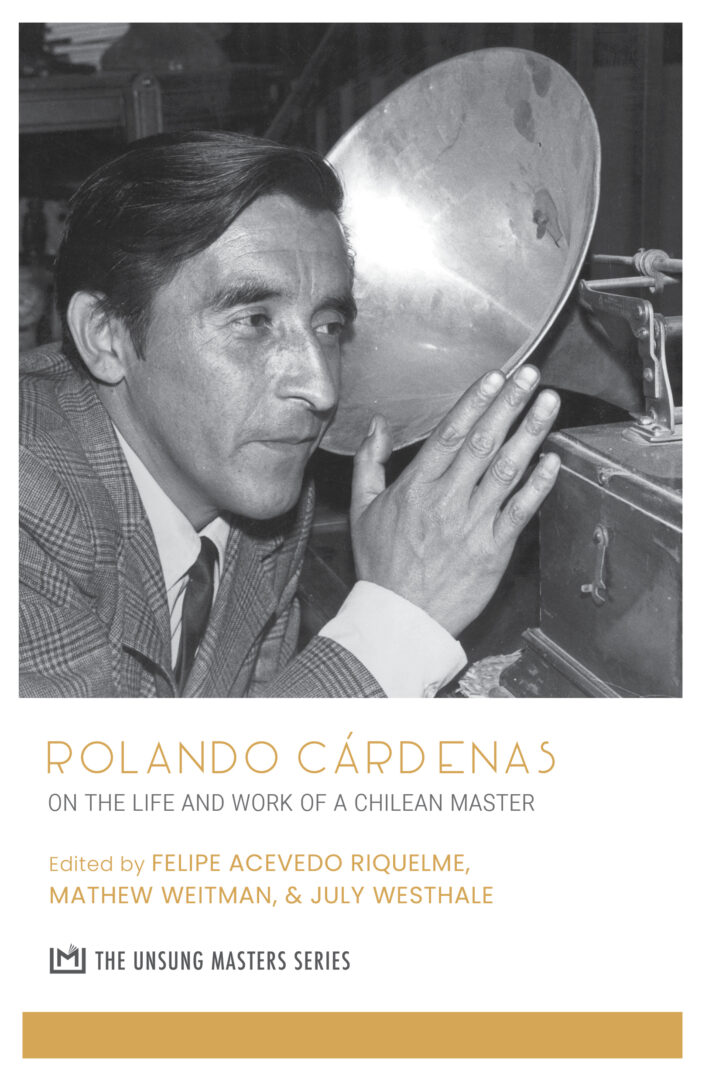
The most recent Unsung Masters volume, Rolando Cárdenas: On the Life and Work of a Chilean Master, presents for the first time in English a selection of poems by this important Chilean poet who was oppressed by the Pinochet regime and nearly lost to literary history. The timing of this volume, edited by Felipe Acevedo Riquelme, July Westhale, and Mathew Weitman, could not have been more prescient, given the erasure being enacted in American streets and against American artists. Their extraordinary work for this volume frames translation itself as a mode of literary recovery—what Felipe beautifully names “Community, Affection, and Repair.” As a result, this volume lives at the intersection of archival work, translation theory, and comparative literary studies, and it contributes to ongoing discourse across these fields. It is also, like all Unsung Masters volumes, a collection of extraordinary writing that deserves much wider readership. In another timeline, Cárdenas might be as well known to us as his contemporaries Roberto Bolaño or Jorge Teillier, but this is one of the many scouring effects of authoritarianism: by suppressing artists, it limits the possibilities for art, until someone recovers this work from the archives.
Cárdenas’s poems, like the work of many poets who write under authoritarian regimes, tend to be coded such that the oppression and impacts of state-sponsored violence are nested elliptically inside imagery, metaphor, and the description of objects. These poems oscillate between dark bars, where poets and artists drink wine together over hushed conversations and loud songs, and the vast Patagonian landscapes of Chile’s southernmost Magallanes region. Recurring themes of imprisonment, memory, and the fear of darkness are seldom ascribed to the human world; often, characteristics of both victimhood and violence are attributed instead to the landscape itself and to inhabitants of the natural world. Cárdenas’s poem “Floors, Creaking” intimates at the terror imposed by the autocrat’s nearly invisible and almost silent disappearances, often in the dead of night.
Floors, Creaking
At night, places change
& sounds sicken even
the most sanctioned ears.
Everything is full of earth: torrents of dirt
cover & crunch down upon us
until we disappear, like apples.
The sound of wood shifting in the night:
when no one touches it,
when no one harms it.
The darkness searches for us—
surprises us: magically shows
us that we are passing through it.
& we hear the wooden sound,
in spite of this change.translated by Mathew Weitman
This poem is about the way state-sponsored violence haunts every home, even those it passes over; even those “most sanctioned.” Anyone who has slept in an old home remembers the unsettling sounds from the roof as the wood heats and cools, just as anyone who has been a child remembers the near-silent sound of monsters waiting to gobble you up and take you away. But only those whose neighbors have been disappeared in darkness can hear, inside “the sound of wood shifting in the night,” “the torrents of dirt / cover & crunch down upon us / until we disappear like apples.”
The wood, in its haunting bodily voice, tells us that even “when no one touches it, / when no one harms it,” someone else, somewhere, is being touched, someone else is being harmed. This poem is a warning that when the state harms anyone, they harm us all. Americans who are not currently in hiding, whose families have not been disappeared or threatened, might deny that this poem is relevant to their own America; that these sounds can’t yet be heard inside American homes. That I am able to write this essay in this way places me among those who cannot hear the wooden sound, or at least among those who do not fear it will ever come for us. But I wonder if we’re listening closely enough. Certainly we are passing through it. Certainly there are torrents of dirt.
Cárdenas is a poet obsessed with solitude, and perhaps this poem can help us understand why: in silence, in the dark of night, every sound becomes the potential of a footstep arriving to carry him away. Under these circumstances, any sound of a house settling, any “wood shifting in the night” becomes the weight of a masked man finally come to claim him. So this poem is more than a warning; it is a demonstration of how violence and the threat of violence change the nature of our experience of the world, even inside the perceived safety of our homes. And it is important, too, that under authoritarianism even those who support the regime, those “most sanctioned ears,” are ultimately sickened by the terror it brings.
Cárdenas asks the objects in his poems to speak because he understands that language draws attention to the speaker—and he has experienced firsthand what it means to have one’s language targeted by the state. Pinochet burned books and banned words; he erased songs and smashed the instruments used to play them; he shuttered newspapers, seized radio antennas, imprisoned artists, disappeared poets, rewrote scripts.
In America, too, the current regime began with the flattening of language. It scrubbed government websites of words that might be written in the margins to condemn or criticize: “injustice,” “advocacy,” “bias,” “racism,” “privilege.” In erasing language, it forecasts what it seeks to erase through violence and the threat of violence: “immigrants,” “Black,” “Native American,” “Latinx,” “females,” “trans,” “vulnerable populations.” It cut funding for artists and arts organizations, writers and literary organizations, educators and universities. It began renaming: the Gulf of Mexico to the Gulf of America; the Department of Defense to the Department of War. The Supreme Toddler, in the lineage of Great Leaders, is stamping his blunt and ugly name and face on every building and institution within reach.
Compared to the immediacy of the violent images and videos being shared, an attack on mere language feels unworthy of our attention. But it is not. Fascism limits language because it is language that sets us free. Authoritarians abhor poetry because poetry teaches us how to love what we do not understand.
Authoritarians abhor poetry because poetry teaches us how to love what we do not understand.
Poets and readers of poetry understand that poems can unlock historical events in ways no other medium can. We also understand that certain themes ebb and flow across history, such that the present moment in America feels familiar rather than impossible. But we tend to share the same poems by the same poets over and over again, when there are so many other works that can expand our awareness and awaken our critical attention. The poets in my life are sharing important and familiar work by Akhmatova, Szymborska, and Celan; my social media feeds are dappled with quotes by James Baldwin and Langston Hughes, and also with work by contemporary American poets like Ilya Kaminsky, Layli Long Soldier, Danez Smith. These poets remind us that poetry extends our consciousness and connects us across great distances of time and place. They remind us that, as Langston Hughes writes, “America never was America,” and yet “America will be!”
One little-known American poet whose work I found in the Ploughshares archive is Shreela Ray. I first learned of Ray thanks to the extraordinary 2021 Unsung Masters volume Shreela Ray: On the Life and Work of an American Master, edited by Kazim Ali and Rohan Chhetri. She is also one of the poets included in Other Legacies.
Shreela Ray was born in India and emigrated to the U.S. for college in 1960. After attending Breadloaf and the Iowa Writers Workshop, her work was championed by Galway Kinnell, W.H. Auden, and John Berryman. In Iowa, she met a fellow student, Hendrick de Leuw, an immigrant from Amsterdam, and they married and lived in Rochester, NY, until her death in 1994. Ray’s life was full of a deep commitment to American poetry and American communities of poetry, such that Cornelius Eady has acknowledged her as “one of the strands of the DNA that built Cave Canem.” Upon publication of her first book, Night Conversations with None Other, the National Book Award jury requested she send them a copy; after requesting this, they refused to consider the book when they learned she was not an American citizen. In a letter of response, she wrote, “my experiences and my language are of this country and its people—a nation of immigrants with whom I have spent seventeen years.” Despite her many champions and the undeniable excellence of her work, despite dedicating her life to American poetry, her legal status relegated her to exclusion from the upper echelons to which she rightfully belongs. She never published another collection during her lifetime.
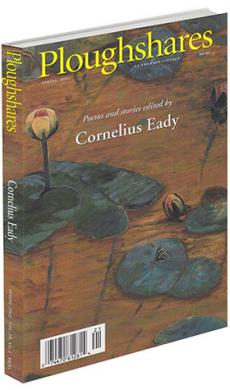
This loss is felt in Ray’s poem “Cruelty,” published in the Spring 2002 issue of Ploughshares edited by Cornelius Eady. Her work is ahead of its time in its refusal to look away from the performance of racial empathy and also the insidious way the American racial caste system infiltrates and corrupts every American relationship. It is a system, she reminds us, that is deeply embedded—and one that limits us all regardless of how we are sorted.
by Shreela Ray
The furrows deepen on your forehead
as you watch the TV story of Chief Joseph.
Later, as your amber eyes—two villages,
fade into the darkness, I deliver
a knockout without mercy,
“Does marrying me make you feel good?”
Some have been known to bob up with
“Somewhere in my bloodline is a Cherokee.”
Your sad voice answers me,
I still believe in the democratic process—
and you disappear and cover the darkness.
This poem is extraordinary in its ability to layer our intersecting histories of settler colonialism and racial hierarchy into a mundane, domestic scene. A married couple watches television—what could be more American? And yet this couple (and the stilted conversation that follows) is a microcosm of the resentment that builds in unequal societies. When the speaker asks, “Does marrying me make you feel good?,” she reminds her white husband that their country sees them differently, though they are both immigrants. She asks, perhaps earnestly but also with an intent to hurt, how it is possible to be white in this country and still “feel good:” about oneself, about the systems that arbitrarily deliver privilege and abuse, about the legacies of our bloodlines. Does this marriage absolve him of his own complicity and guilt, she asks. But there is an undercurrent of sex in the phrase as well. To “feel good” is a bodily experience; she also asks him to acknowledge his fetishization of her brown skin, and in so doing, to acknowledge his fetishization of the racial caste system. Everything becomes doubled: the furrowed brow; the eyes which are also villages; the darkness into which they fade; the darkness which he covers up, as in hides, as in skin.
Equally masterful is the poem’s awareness of form as a vehicle for critique and resistance. “Cruelty” is not a sonnet, but it could almost pass as one: it has the look and the feel of a sonnet that has been broken. It is not written in iambic pentameter but demonstrates metric awareness. It acknowledges and resists the shape of colonialist history as form. In the middle couplet, the poem breaks the moment and contains a knockout volta: Americans lay claim even to the identities of those communities we have tried to erase. Even in our love we subjugate; it is a party trick of cruelty. But if we are to read this poem in the lineage of sonnets, we must also ask about the poem’s missing lines: a sonnet has 14, while this poem has only eleven. As Roethke writes, “In a dark time, the eye begins to see.” So to see what is missing, to unmask it, we can look to that which is described in the poem as disappearing or in danger of disappearing: the villages, democracy itself, the darkness which Ray uses as a metonym for ethnic diversity. We can also look to the choice of the documentary’s focus, Chief Joseph, who famously said at the end of a long war with the American government, “I am tired; my heart is sick and sad. From where the sun now stands, I will fight no more forever.”
In the end I’m not sure how to read this poem as a model for resistance, exactly; like the best poems, it is not reducible to a single stance. It is an indictment, to be sure. And it helps us to understand the current moment in the context of a long history of struggle for human rights. Certainly, this critical understanding is itself a kind of resistance. But the famous lines by Chief Joseph are absent. There is no surrender here; instead, small acts of resistance play out in conversation with people we love, even when we mean to question or challenge their love. And this poem, like Shreela Ray’s biography, reminds us of the erasure and exclusion of immigrants that is playing out across our country. It asks us who gets to be American, and why. It is a remarkable poem from an American poet who was not embraced by American poetry. Let us embrace her now.
As with the “missing” lines in Shreela Ray’s broken sonnet, it is not possible to consider an archive without also considering what is missing: curation is inherently selection, exclusion, tastemaking, gatekeeping. If we are not careful, literary recovery can extend or amplify the trends and mistakes of previous eras, and of our own. If we rely only on the measures by which we judge and assess contemporary work when reading the archives, we can also inadvertently reinforce the same stories we’re being told; further entrench and disentangle and tidy up the complexity of the past to retell (and to resell) stories that protect what we assume to be incontrovertible truths about the present. I recall from my days as a doctoral student a beautiful argument, in the Jung Center in Houston, between Roberto Tejada and Tony Hoagland about whether Truth exists. I’ll leave it to the reader to guess who argued which side. Often, to expand our sense of inclusion, we must seek to move against the currents and instincts of our time. We must look to the margins.
The Ploughshares archive is especially fascinating as a record of the interplay between the margin and the main body of literature. It offers not only a vision of literary taste during a particular moment in American history, but it also shows us that moment through the lens of poets who have become canonical, often at or near the moments of their becoming. It shows us what they have valued, who they have read, and how they have shaped and been shaped by intersecting literary communities. Because Ploughshares is the work of many minds, it hedges against the myopic focus sometimes contained in other archives: by extending literary gatekeeping to a community of writers instead of limiting it to a small handful of individual editors, it is, as a system of keeping literary history, broader and more complicated and more inclusive than many other journals and many other archives.
This community-led approach to literary editing aligns with the approach my fellow editors, Adrienne Perry, Kevin Prufer, and I have taken in editing Other Legacies: Great Unsung American Poets. Instead of choosing poets for inclusion ourselves, we’ve invited thirty-five prominent American writers to select and introduce the work of poets they believe to have been unjustly overlooked. Among the contributors are Kazim Ali, Rae Armantrout, Edward Hirsch, Victoria Chang, Ilya Kaminsky, Dana Levin, Adrian Matejka, Vijay Seshadri, David Baker, and many others—poets whose judgment and vision we trust to identify work that deserves greater readership. Because this approach to literary recovery is deeply tied to community and because it celebrates diverse perspectives and uncommon stories of literature, we hope this book can act not only as a tool for learning and exploration but also as a tool for renewal, reconfiguration, and resistance.
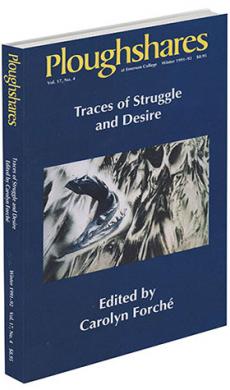
Often, as with Cárdenas, embedded in the work of recovery is the work of translation. Though translation is not the focus of this essay, it is perhaps telling that two of the three poems discussed are translated. The work of translation can be considered alongside literary recovery as an act of resistance to the erasure of language. And also like archival work, translation exists in the context of linguistic colonization, imbalanced power structures, and extractive economic and ecological systems; translations can therefore both resist and potentially extend colonial frameworks or hierarchies. Take for example, “The Garden of Theophrastus” by the German poet Peter Huchel, translated by Daniel Simko for the Winter 1991-92 issue of Ploughshares, guest edited by Carolyn Forché. In addition to enacting literary recovery as a translated poem being pulled from the archives, it is a poem explicitly about the importance of archives and literary recovery work. What’s more, it places this work in the context of survival under fascism.
Huchel was a German poet who withdrew his first award-winning manuscript from publication in 1933 to protest the Nazi rise to power. Like both Shreela Ray and Rolando Cárdenas, the trajectory of his creative life was impacted early by political currents and the spread of authoritarianism, to which he publicly and consistently objected. Also, like both Ray and Cárdenas, his work became a tool to resist and critique what he saw. Though Huchel is well known among German poets and readers of poetry, he deserves much greater recognition among American readers, especially given the overlap at this moment in our history.
The Garden of Theophrastus
by Peter Huchelto my son
When the white flame of verses
Dances above the urns at noon,
Remember, my son. Remember those
who once planted their conversations like trees.
The garden is dead, my breath is heavy,
Preserve the hours, here Theophrastus walked
Fertilizing the soil with oak bark,
Binding the wounded bark to the tree trunks.
An olive tree splits the brittle ruins
Remaining a voice in the dusty heat.
Their orders were to cut it down and root it out.
Your light is fading, defenseless leaves.translated by Daniel Simko
Here we have another near-sonnet; a breaking of form reflected in how the olive tree “splits the brittle ruins.” This poem’s primary image of a dead garden is so heavy with loss and the aftermath of loss it feels immediately relevant to today’s America. Just yesterday, a neighbor told me she felt as though she was walking through a haze; that her brain wasn’t quite working. “The garden is dead,” she could have said. “My breath is heavy.” This haze is one of the intentional outcomes of fascism: we are made to feel overwhelmed and sad and afraid, such that our capacity to resist and to critically engage becomes strained.
But it is not only the loss of the garden that makes this poem so heavy: it is also the performance of inevitability; that in the final line, even as the young tree grows and splits the ruins, the light is fading. Because the poem is dedicated to his son, it reads as a direct address to him: “your light is fading.” At first, we might read this pessimism as a form of “obeying in advance,” but the complexity of this poem supports a more layered reading. In becoming the tree, the son also becomes the force that splits the brittle ruins, that has the power to crumble what is left of the regime. And if we look closer still, it is not the son, nor the tree, whose light is fading; it is the “defenseless leaves.” As the leaves lose their light, the flames of verses grow brighter. And olive trees shed old leaves as the new leaves come in each spring. This is how the tree makes space for new growth, and for Huchel it is another metaphor about intergenerational legacy. The light lost is implied to return again. Huchel is in fact not condemning his son to darkness; he is teaching him how to encode language, such that a performance of despair can also contain a map to resistance and resilience. Which is to say that this poem does not only document loss; it documents strategies for survival and resistance under fascism, from a poet seeking to simultaneously protect and initiate his son.
To survive, the poem suggests, any image of hope must be hidden inside an image of despair, like a series of nesting dolls. Like Ray’s “Cruelty,” in which each image occupies multiple temporal spaces and postcolonial critiques, Huchel’s images are always pointing in opposite directions at once. It teaches us how the performance of allegiance can hide subversive verses. Huchel’s flame is also a poem, which is also the seed of the garden, which is also conversation, which is also an olive tree, which is also his son, who also splits the brittle ruins, whose life and strength is only beginning as the speaker’s strength wanes. I’d say the image transforms, but it does not. It remains all these things at once, as if to suggest that time itself is not linear. It is more mystical than narrative, like a white flame floating above an urn. Only now do I see that the urn contains the ashes of Huchel himself.
Like Cárdenas’s “Floors, Creaking,” Huchel’s poem offers strategies for survival under a fully entrenched fascist state. In this way, these poems are more warnings than reflections of today’s America. At least some of us can still speak plainly and resist openly, without performing allegiance or inevitability. We’re still planting our conversations like trees. Unlike Germany in the 1930s, Americans are in the streets, resisting. And we owe an immense debt of gratitude to the people of Minneapolis who are organizing to support each other, and to observe and condemn the actions of masked federal agents, even under the risk and threat of death. They teach us to love our neighbors not in spite of our differences, but because of them.
This brings up another interpretation of this poem that better reflects where we are now in America: even in the performative pronouncement of its death, the garden is not dead, and it is not neglected. The looming “they” whose orders are “to cut it down and root it out,” exist only in the threat of their presence. They cannot invade every city with their bodies (yet), so they invade with their threats. The leaves may be defenseless, but as their light fades, the light of the verses grows ever more visible. We return to the idea that this poem is about literary legacy: the interplay between the physical (“leaves” as pages) and the eternal (“the white flame of verses”). This is another way of thinking about the relationship of the margin to the main body.This is also where the poem’s invocation of Theophrastus does so much work. Huchel reminds us that a poem, like a seed, is one segment of an endless thread, and that it can transcend familial generations to chart the rise and fall of empires. Theophrastus was a contemporary of Aristotle, who undertook the first systematic Western study of plants and is considered the “father of botany.” To be a gardener is to be a steward of individual plants, but to study botany is to study lineage and biodiversity itself. It is to think and move in timelines greater than human life and death. It is to seek to understand the uncountable variations and manifestations of life, and to celebrate the differences found therein. It is to resist monoculture. In this way, it is also the opposite of fascism, which seeks to constrict knowledge and erase diversity. We are told that this poem is Theophrastus’s garden, which is to say it is tended by the ancients and the dead, and therefore exists outside of time. It is many things, and it is all these things at once.
A quote by James Baldwin has been surfacing and resurfacing in my social media feeds: “The children are always ours, every single one of them, all over the globe; and I am beginning to suspect that whoever is incapable of recognizing this may be incapable of morality.” I can’t help but think of my youngest daughter, who asks every night as I tuck her in, “Daddy, will you come check on me?” I find it sickening to think of the thousands of children this year who have woken up to find their parents missing. That they were not watched over as they slept. That their parents have been removed from their lives entirely. This isn’t only happening in America. But it is happening here, too.
All this violence exists inside the architecture of the attention economy: a way of organizing time that is at odds with the very existence of archives. Because fascism requires the unwavering and absolute gaze of its subjects, it also denies the possibility of any moment but the present. Just as it seeks to flatten ethnic, linguistic, and cultural diversity, it also seeks to flatten time into an ahistoric and infinite present that can be dominated. The relentlessness of this techno-fascist current is the opposite of Walter Benjamin’s “nowtime” (jetztzeit) in which meaningful political action or resistance occurs as disruption of history; instead, because the attention economy reduces the present into a meaningless and infinite scroll, it subsumes any possibility of either a past or a future. It denies us the potential for critical, rhetorical, or recursive self-awareness, and so it denies us the potential for resistance. Poetry then, and perhaps especially poetry written under authoritarian regimes, is not only a tool for encoding resistance but it is also a weapon of attention.
When I scroll mindlessly, which I do too often, I know I’m being conditioned to experience the world in microseconds, in views and clicks, in shares and likes. I am being encouraged to give the machine what rightfully belongs to my children, because attention is also love. These two acts—to scroll and to love—are in direct opposition, even as they are conflated by the very emojis we are offered to understand them. It’s obvious why so many tech moguls stand behind this regime: the relationship between fascism and the attention economy is reciprocal. Fascism, too, flattens time into a series of moments that can be commodified and packaged as an undifferentiated and infinite scroll. Fascism is the opposite of love; it is domination. Domination is the absence of choice and the absence of memory; without these things we have no way of knowing ourselves. We become all the same, all at once. An infinitely dense black hole swallows the earth, and all of us along with it.
But there is also so much hope, and so much work to be done: in its attempt to erase difference, fascism also erases its own vitality. Its insistence on sameness dooms it to be an ouroboros that can only consume itself until it dies. Its only motor is entropy. Its only power is death. Poetry, on the other hand, as Huchel tells us, resists this erasure and this flattening by tending the eternal garden and harboring the eternal flame. As poets and readers of poetry, we offer an interpretation of the world and its conflicts that lives beyond the ephemerality of the present moment. We pierce the moment with a thread that might be picked up again in a hundred or a thousand years, to be threaded again into another moment. Our ability to write and record experience, but also to archive it, to recover it, to share and interpret it, is one of our great antidotes to becoming lost in the techno-fascist scroll. Whether or not we are the unacknowledged arbiters of the world, poets stitch moments and consciousnesses together across great time and distance. We unveil and unmask. We are, in our quiet, stitching and unstitching history.
As Muriel Rukeyser teaches us, “poetry can extend the document” to become the equipment and tools for social change. What we can learn from the poets and from the archive is how to enact this change and how to meet the moment: by setting down the screen and picking up the book; by tending the garden; by watching over our children, for they are always ours, every single one of them, all over the globe; by rigorously holding language, and compassion, and every struggling consciousness in our hands and in our hearts, forever.
Martin Rock is the author of Infinite Scroll (Tupelo Press, 2027), selected by Carolyn Forché for the Tupelo Berkshire Prize, and Residuum, editor’s choice for the Cleveland State University Poetry Center’s First Book Prize and a Foreword INDIE Book Award finalist. With Adrienne Perry and Kevin Prufer, he co-edited Other Legacies: Great Unsung American Poets (Wesleyan University Press, 2026). His chapbooks include Dear Mark (Brooklyn Arts Press) and Fish, You Bird (Pilot Books, co-written with Philip D. Ischy). He has been awarded the Donald Barthelme Prize in Poetry, named runner-up for the Missouri Review Editors’ Prize, and his editorial work for Gulf Coast was recognized for excellence by the Council of Literary Magazines and Presses (CLMP). Martin teaches writing and climate justice at the University of California San Diego, and, with poets Kevin Prufer and Wayne Miller, co-directs The Unsung Masters Series.