Editor’s Note
“Some sacred beings seem to be sacred to all imaginations at all times. The Moon, for example, Fire, Snakes and those four important beings which can only be defined in terms of nonbeing, Darkness, Silence, Nothing, Death.”
This is Auden, from his essay “Making, Knowing, and Judging,” in which he discusses the ways a young writer is informed by early experiences with the sacred. He goes on to say that, outside of the universal and eternally sacred, other conceptions of the sacred are culturally and historically specific. The Artist, for example, has been and continues to be sacred to some, though surely not all; the same could be said of The King, The Despot, The Warlord. Beyond these lie beings and phenomena that are sacred in a singular, personal and particular sense—a foot stepping from the train. As I read Auden’s essay, I found myself thinking back to the flashes and visions of the sacred in my own life—small moments I found suddenly laden with universal meaning. One thing that popped to mind as uniquely sacred to me was the little sleeping noises of my two brothers in the darkness of our shared childhood bedroom. And I don’t mean only to say that those noises were precious, though I suppose in a way they were, I mean that I felt something ominous and vital listening to their small, unconscious snoring and animal grunts. Auden writes:
The impulse to create a work of art is felt when, in certain persons, the passive awe provoked by sacred beings or events is transformed into a desire to express that awe in a rite of worship or homage, and to be fit homage this rite must be beautiful. This rite has no magical or idolatrous intention; nothing is expected in return.
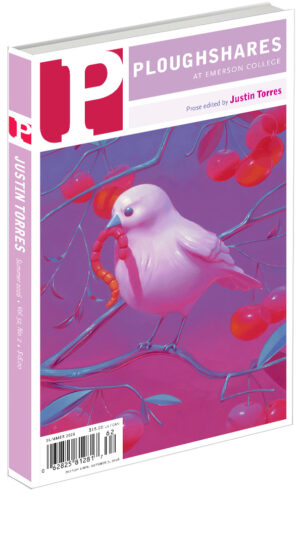
This seems right to me. What follows are stories, essays, vignettes, prose poems, all of which Auden would have us consider as rites of worship. Not worship of “God the Redeemer,” but worship of the sacred particular, and worship, too, of the universal nonbeing: Darkness, Silence, Nothing, Death.
After reading through the issue, it will be clear why I begin this introduction by quoting a poet. I love story, but my attraction is always to language over plot. Some of these pieces I solicited from writer friends, a couple of those friends were once students, others I chose from submissions sent to the magazine and forwarded on to me. More than anything, my criteria was the transcendent shaping of words, the exact right turn of phrase. A partial list of the sacred objects and moments I encountered: turquoise sea striking against black lava stones; the useful trees of Gaza; tree-like Daphne; quicksand; Liza Minnelli; last words; the sigh sent forth from the heaving bosom; goose bumps; birthmarks; a faded phone cord twirled around an index finger; the engine whistle; the point of no return; carrying on. The great pleasure of editing this issue of Ploughshares has been the surprising beauty and reflection, depth, and sense of mystery that animate its contents. And to know that in difficult times, still we find time to make art. The authors gathered here carry forward Auden’s particular sense of the sacred, and a sense of literary art as a necessary rite of response.