Some Day
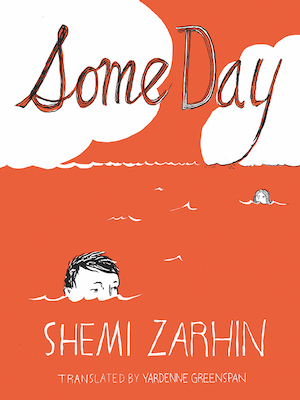
Some Day
Shemi Zarhin
Trans. Yardenne Greenspan
New Vessel Press, October 2013
$16.99
450 pages
What: Epic family drama
With lots of: Food
Also: Lust, love, loss, and longing
Where: Tiberias, by Israel’s Sea of Galilee
When: 1969-1983
Concerning:
- Shlomi, a child who develops near-magical culinary talents
- Hilik, his little brother who collects words
- Ruchama, their strong, “tall as an electric pole” mother
- Robert, their petite father with Samson-like hair and extra-marital affairs
- their neighbors, crushes, and lovers (Sephardic, Ashkenazi, Kurdish, Arabic, Holocaust survivors and children of)
- a couple suspected witches
- a mad, abused donkey
- and, the western wind that grows “wild and savage” every Wednesday
Narrative mode: Spiraling. The story curls in on itself, repeating and building upon moments of rapture and rupture, as family stories and memories—and national histories—so often do.
Tones: ardent, salty, whimsical, steamy, absurd
For example:
The bathroom’s balcony was dark and filled with plastic pails. Robert and Hanna stood there, almost touching, and Hanna whispered, “Why are you breathing so fast?”
“I’m looking at you and my heart is burning,” he whispered back.
“You need to wipe your nose,” she whispered, and Robert wiped his dripping nose [….] And then her lips attached to his, her eyes closed and his mouth drinking hers, which tasted like tomato and salt.
Oft repeated, striking image: Ruchama’s observation that Holocaust survivors were “ground” into “human powder”
Most repeated idea: “Life is a poem.”
Most lovely repeated idea: Hilik’s love of “[w]ords like fire and duskiness and gloom and treetop and fig leaf and udders and evil and sourness and thrust and torrent and cleaver and darkness and annihilation [….]”
Central questions:
- How do we avoid repeating the past?
- How do we not pass on our mistakes to our children?
- Are our mistakes embedded in our DNA?
Minor hitch: In the last half of the novel, the narrative occasionally sags beneath the weight of all the intentional repetitions and doublings and the pointing out of these doublings.
However: The spiraling and repetition are successful in delivering a wallop to the reader, as the death of a main character is made all the more affecting—and all the more crucial to the whole project of the story and its necessary questions.
You should read this book because: Just look at this totally uncritical breakdown of marginalia:
- # of 🙂 : 25
- # of 🙁 : 15
- # of !!! : 28
- # of ♥ : 4
Further reading, for more steaminess and longing: Love Life, by Zeruya Shalev
Further reading, for more magic and whimsicality: anything by Etgar Keret