So, we’ve talked about the beginning, the end, pluck, resiliency, and life—and yet here we are, still, wading through the slush pile. How many licks does it take to get to the center of a Tootsie Roll Pop? The world may never know, and how to have a reader pass on your work feels just as elusive. A tip: nothing is more effective than good dialogue to keep a reader engaged, and nothing can turn a reader off faster than schlocky conversation. Picture Charlie Brown listening to his teachers: womp, womp.
Author, Elizabeth Bowen, says, “Dialogue is what people do to each other.” It should be used to convey attitude, not information. When dialogue is used for exposition it sounds stilted and almost always falls flat, taking the reader out of the moment. Dialogue, when done right, provides economy in revealing character through word choice, dialect, and inference, to name a few. Done well, it pushes your story forward by suggestion. Mark Twain says, “The difference between the right word and the nearly right word is the same as that between lightning and the lightning bug.”
When Jim Shepard guest edited Ploughshares, he said he’s “drawn to protagonists who leave us to sort through what they’ve figured out, what they can’t figure out, and what they won’t try to figure out about themselves.” These are stories rich in subtext, and one of the best ways to deliver subtext is through dialogue. If you think about it, often the purpose of conversation is to conceal genuine feelings; what is not being said is more important than what is revealed on the page. The omissions deliver true character.
One of the most important tools for clawing your way out of the slush pile, however, is also the effective use of summarized dialogue. Not all conversations are worthy of direct speech. The overuse of he said/she said diffuses the power of the words you are trying to deliver. Take a look at Amy Hempel’s, “In the Cemetery Where Al Jolson is Buried:”
“Tell me things I won’t mind forgetting,” she said. “Make it useless stuff or skip it,” she said.
I began. I told her insects fly through rain, missing every drop, never getting wet. I told her no one in America owned a tape recorder before Bing Crosby did. I told her the moon is like a banana—you see it looking full, you see it end on.
If Hempel delivered all of that in direct speech, you would lose the power of what is quoted, the richness of the details, the pacing and it would most likely add a certain sentimentality that would not serve the story. Mastering summarized dialogue can be tricky. To really understand it, go to the masters and copy down their prose and try to feel how it works. Take the summarized dialogue and transform it into direct speech, so you can really understand the choices they made. Then go back to your own work and see where you can economize.
For me, a go-to book in dialogue and subtext is Elizabeth Strout’s Olive Kitteredge. You also can’t go wrong looking at any of these stories:
Those are some of my favorites, but take a look at any author you admire and see what they do with dialogue. In practicing your craft you have to keep reading.
Sometimes reading the greats, makes me feel like my own work will never measure up—but Richard Bausch says, “When you feel global doubt about your talent, that is your talent. People who have no talent don’t have any doubt.”
A few days before my son was born, my parents and sister came to Princeton, where my husband and I lived at the time, to witness the birth. They had found a sublet a few blocks away from our apartment, but my mother wanted to spend the first few nights after the birth with us.
Everyday in Airstrip One (the country formerly known as England), Winston Smith goes to work. At work there is a girl named Julia. Winston gets pretty nervous around her because he’s convinced she’s part of the Thought Police.
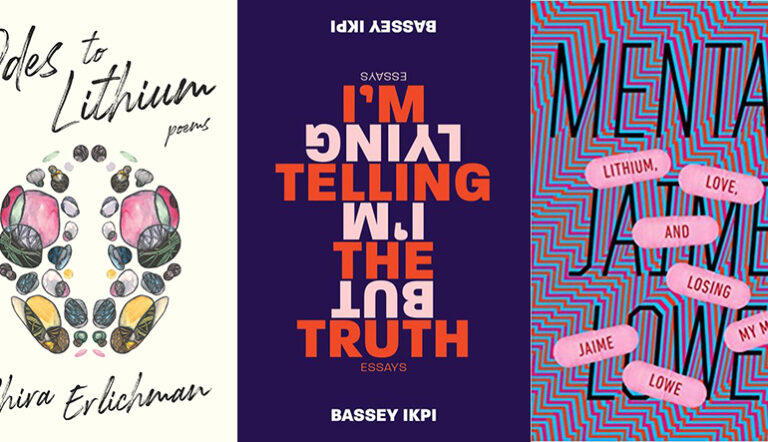
For bipolar disorder, the most tried and true treatment—the most effective one—doesn’t come from a lab; it comes from stardust. It’s an element on the periodic table, atomic number 3.