Tommy Orange: An Introduction to The Best Short Stories 2026
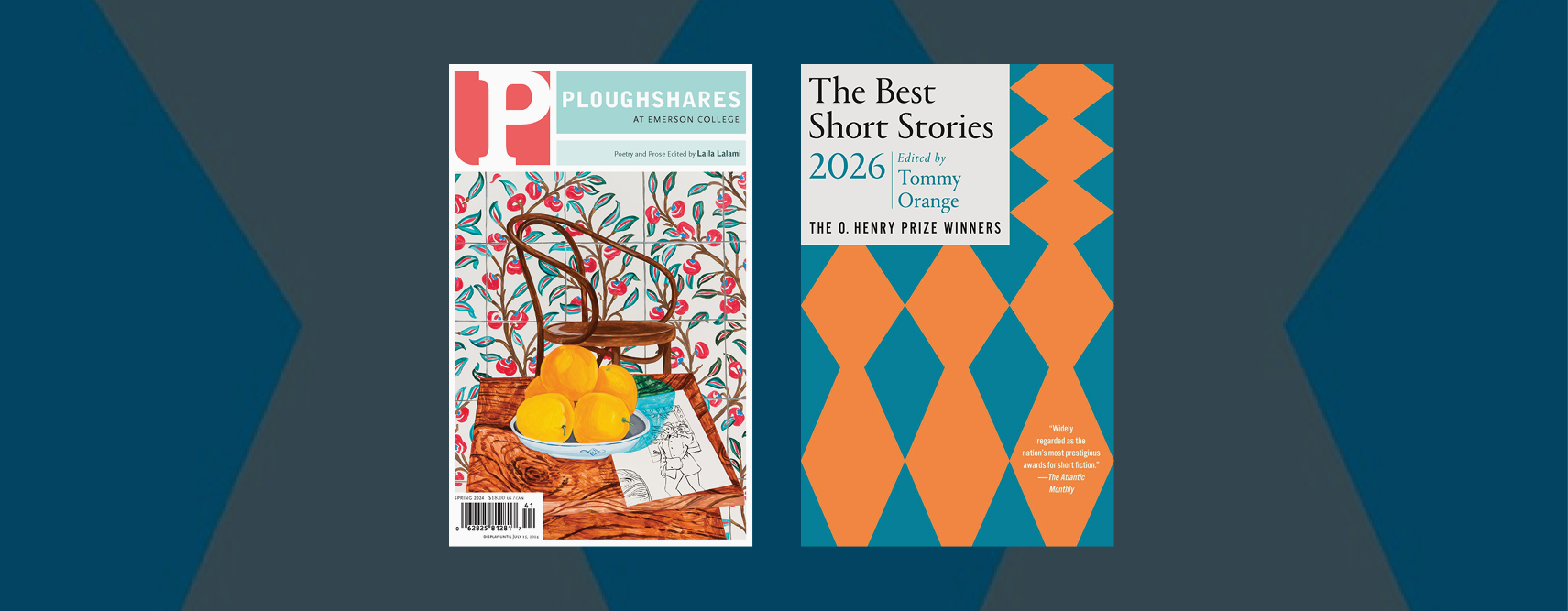
Ploughshares is pleased to share a sneak peek of Tommy Orange’s introduction to this year’s Best Short Stories: The O. Henry Prize Winners anthology, which publishes September 29, 2026. The anthology, edited by Orange, features new work by former guest editor Colm Tóibín, and past contributors Jenny Xie, Weike Wang, and Kevin Wilson.
Writing fiction for me started with the short story. This was about a year after I first realized I loved reading fiction by writers like Borges and Kafka, Clarice Lispector and Robert Walser, the even more obscure Tommaso Landolfi, and Felisberto Hernández. Everything in translation. I was trying to translate an ineffable childhood I was both running away from and outgrowing. Reading at first was related to my attempt at recovering a sense of meaning, a nonreligious spiritual-something I was seeking without even knowing I was seeking it. This after an intense childhood in an evangelical church where people regularly spoke in tongues, were slain in the spirit. I believed the world would end before I turned eighteen, and that my soul was in need of saving, if only I could get Jesus into my heart somehow, and then I didn’t believe in any of it. And here came fiction.
So what got me into reading fiction I guess was the voice-y, philosophically weird stuff. Everything regarding reading before that I thought of as school, and school never made sense to me. I grew up with a story about a massacre, was told we were the descendants of a people who survived that massacre, and that that massacre was a part of a genocide carried out by the U.S. government. The institutions of school and government didn’t seem like separate things to me. Neither did we read books at home aside from the Bible. But even a book like the Bible couldn’t hold a candle to a worship service gone off the rails, to seeing your own mother speaking in tongues, your sister slain in the spirit on the floor in the aisle of the church.
There was a moment, must have been fall of 2005, after reading A Confederacy of Dunces and The Bell Jar, where I came to understand that there were people who committed themselves to writing in the most serious way possible, and then to suicide. These people were doing something with language in the novel, were doing something transcendent with voice and story. They were writing like their lives were on the line, pushing their demons out through art, even if it left them spent after. I set about writing as much as I could once I got it in my head that I wanted to try to write fiction. I’d learned discipline from a life as an athlete, a roller hockey player, and then a musician, piano and guitar mostly, graduating with a bachelor of science in the sound arts. I knew you had to put in the time. The hours. But how do you practice writing? It’s not built-in. Seemed to me like you had a story to tell or you didn’t. I wrote experimental short-form stuff. Bought exercise books. Typed out pages of writing I loved. Read like I was decades behind because I was. Eventually came to understand that there was a thing called a short story. All different kinds of ways to do it too, all different lengths, everything from the short short to the very long short story—sometimes called a novella if it got long enough. And as it turned out, with Borges, Kafka, Lispector, Walser, Landolfi, and Hernández, that was what they’d been doing—that thing that I loved that they were doing, those were all short stories!
I went from writing the weird stuff to incorporating my life and experiences into the characters in my stories. I started thinking about other people reading what I wrote. I joined Craigslist writing groups. I made my friends listen to me read what I’d written.
I don’t know how I first heard about the Zoetrope short fiction contest. I have a memory of staying with a friend somewhere near Napa when I was maybe ten, knowing the place we were staying was owned by someone in the Coppola family. Everything was made of wood. And there was a hot tub. I wasn’t a film person. Wasn’t an art person. That trip was how I knew the Coppola name. So when I found out about the magazine, and there being a contest, it was enough to convince me to try. Every year for the next seven years I entered that contest. And as each year passed I believed less and less it was possible that I could succeed in any way at writing. I kept writing short stories. Reading everyone I’d read had perfected the form. Hemingway, Hempel, Carver, Munro, and then more Borges, more Kafka, and more Lispector. On the seventh year, in 2013, I got an honorable mention. I was headed to a month-long artist-in-residency in New Hampshire. I used the belief I banked from the feeling to apply to an MFA program. I’d started writing what would become There There, which I conceived of as being made up of short stories that could stand alone but would ultimately work together to make a novel.
The short story will always be at the heart of what drives reading for me. My agent recently told me collections do not sell. I don’t know why. Selling is not the point. But we as writers do write hoping to be read. We pour ourselves into an art form in order to be understood; we translate ourselves, through story, to reach other people, so that they might understand the world better, might feel less alone in it.
We usually read in chunks at most amounting to short-story length. The idea of trying to capture a reader’s attention at all moments of a work is at the heart of any story, which means creating a beginning, middle, and end. Which means creating a compelling voice to carry the story into the reader’s brain and heart.
I’ve been honored to read a vast array of stories people published in 2025, to get to choose these twenty, help bundle them together here, honoring the legacy of a man who most famously wrote about a cosmic irony involving Christmas gifts, O. Henry. And I am truly grateful just being able to read them, have them become a part of my life, and to get to be part of this long-running, beloved anthology series.
These stories are all brilliant in their own ways. All have distinct voices and speak about the world right now, not just this year or last, but the feeling of what it’s like to be alive right now, because that is generally when they were written. They are laugh-out-loud and quietly funny, complex, mythical, mystical, absurd, but always carry you through them with the care of a writer, a storyteller doing their work at the sentence level to bring their voice and their characters to life on the page.
I wasn’t sure how to speak about all these stories at once. So I thought I’d highlight some sentences that shot through me when I read them or drew up hairs on the back of my neck, made me read them three, four times in that way that isn’t a misunderstanding, but a deepening of something you at first thought you got. If a letter is like a cell, let’s say, and a word like a single-celled organism, then a sentence is the multicelled organism, which wasn’t a given, but a leap, almost of faith, in the evolution of life, from which all complex life became possible. And sentences can feel like miracles, especially the way they’re situated in a short story. The kind of sentence that convinces you of an author’s authority, or just to keep reading, it can come at the beginning of a story, like the hook in a song, or somewhere in the middle, like the lifting of a weight you couldn’t feel until it was lifted, or it can knock you out at the end, take all the air out of your body, move a cloud in your brain with the wind of it.
A darling sentence, or sentiment, or piece of advice in the writing world, is to kill your darlings. I don’t agree with this. I say save your darlings. Fix what surrounds them so that they might survive. Have them land on the page in a way that makes them feel undeniable. If they are in fact dear to you, your darlings, then honor them, anthologize them.
The first sentence that struck me when reading these stories was in Kimberley Blaeser’s “Waiting, a Quintet.” Early on in the story, our narrator says, “Maybe that’s why we find little help for the dark trouble some of us live in.” There is so much here. The dark trouble that some of us live in. The choice of words here is devastating. The darkness of trouble, to be trapped, to live “in” it. The finding of little help. A world is being constructed early on here, an emotional one; a door is being opened into it, and it swings on the broken hinges that still work but maybe not for long. Such sentences contain a truth, make you say to yourself: Yes, I know what is being spoken of here, this is how it is, this is real.
And then in Brandon Taylor’s “American Realism,” inside a story that tells us we need music, art, to deal with something as impossible to deal with as death, grief, we have, “The music changed after that, still progressing, but somehow inflected with a new sadness, so that in its steady forward motion, it became a perfect expression of seeking happiness in dire straits.” I believe we do that every day. We seek something better during the darkest of times. These stories helped me through personal dark times as well as the mess playing out on a global scale.
Or in Guka Han’s story, “Earshot,” speaking of the discovery of music itself, amidst pure noise, we have, “I could no longer hear the ambient din of our apartment—I was only aware of these specific sounds, of this rhythm and these melodies that now came to me so clearly, and for the first time in my life, I understood what the word music meant.” Are we not trying to find the music amidst the noise of the internet, AI slop, our fruitless doomscrolling and strange attraction to brain-rot content? At other times a story might speak to what we do in relationships, as in Weike Wang’s story “Case Study,” where a character thinks, “She wasted a lot of mental energy trying to disprove this fact,” about her husband’s insistence that she and her parents talk over each other too much. What could be more relatable than the lamenting of lost time to the mental activity of trying to prove your romantic partner wrong about something? And then later in that story, as if to compartmentalize or shrink the feelings of her husband altogether, “She takes her husband’s name card and folds it repeatedly until it is just a tiny, insignificant square.”
Maybe it’s a hard sell, during times like these, to say that you should read these things people made up. I happen to believe in the transformative power of art, in small, almost unnoticeable ways as well as contributing to massive social, psycho-spiritual change. And stories themselves are not static, unchanging things. Zoetrope asked me to submit a story back in 2019, and earlier this year that story got made into a short film. It’s called Freyr, and it’s about a guy with an extra hand growing out of his chest. And in the next issue of Zoetrope I have another story being published from my third novel. I’m sharing this news because short stories, while being self-contained, complete and whole things unto themselves, are also seeds, possible promises of something continuing to grow, and often leave you feeling that way when you finish reading them.
I do think, while I felt convinced by the conviction, the commitment, of Plath and Toole, that they were going to their art forms to be saved by them, that they died trying to save themselves with language, and with story. I know that writing, that stories, that art, has saved my life, continues to save my life, continues to give me hope and that intangible, untouchable, immutable thing I keep returning to writing and reading to find, a secret satiation to a hidden hunger for something that can’t be explained except through story.
I believe the best of what any art can do is make you feel that your own life, the life you share with everyone, life itself, is more alive and full and complex than you sometimes give it credit for being, when you sometimes dismiss it as cruel or unfair or boring or any of the ways we tend to point at all of life and try to drag it down to meet us at our mood, our current circumstance. I think the best short stories are a microcosm of human life itself, the story of human life, or one of the vital parts of its machinery, the thing that keeps it going, keeps us going.
I’ll end here with a quote from the first story in the batches of stories I was reading to get to the final version of this book, and it’s from Kevin Wilson’s story “All Stories,” which I was perhaps extra enamored by because of the way rollerblading played into it, me being a former roller hockey player and enthusiast, and it’s about a writer realizing that stories can do something for him that keeps him from wanting to die. “It wasn’t like everything got better for me, because it was still so bad, but I liked reading these stories.”
Tommy Orange, Oakland, California, December 2025
From the introduction to The Best Short Stories 2026: The O. Henry Prize Winners, edited by Tommy Orange; series edited by Jenny Minton Quigley. Reprinted by permission of Vintage Books, an imprint of The Knopf Doubleday Publishing Group, a division of Penguin Random House LLC. Copyright © 2026 by Vintage Books. Introduction copyright © 2026 by Tommy Orange.
Tommy Orange is a graduate of the MFA program at the Institute of American Indian Arts. An enrolled member of the Cheyenne and Arapaho Tribes of Oklahoma, he was born and raised in Oakland, CA. His first book, There There (Knopf, 2018), was a finalist for the 2019 Pulitzer Prize and received the 2019 American Book Award. He lives in Oakland, CA. (Updated 04/2024)
Tommy Orange, Bell