All the Question Marks Began Singing: An Interview with John Skoyles
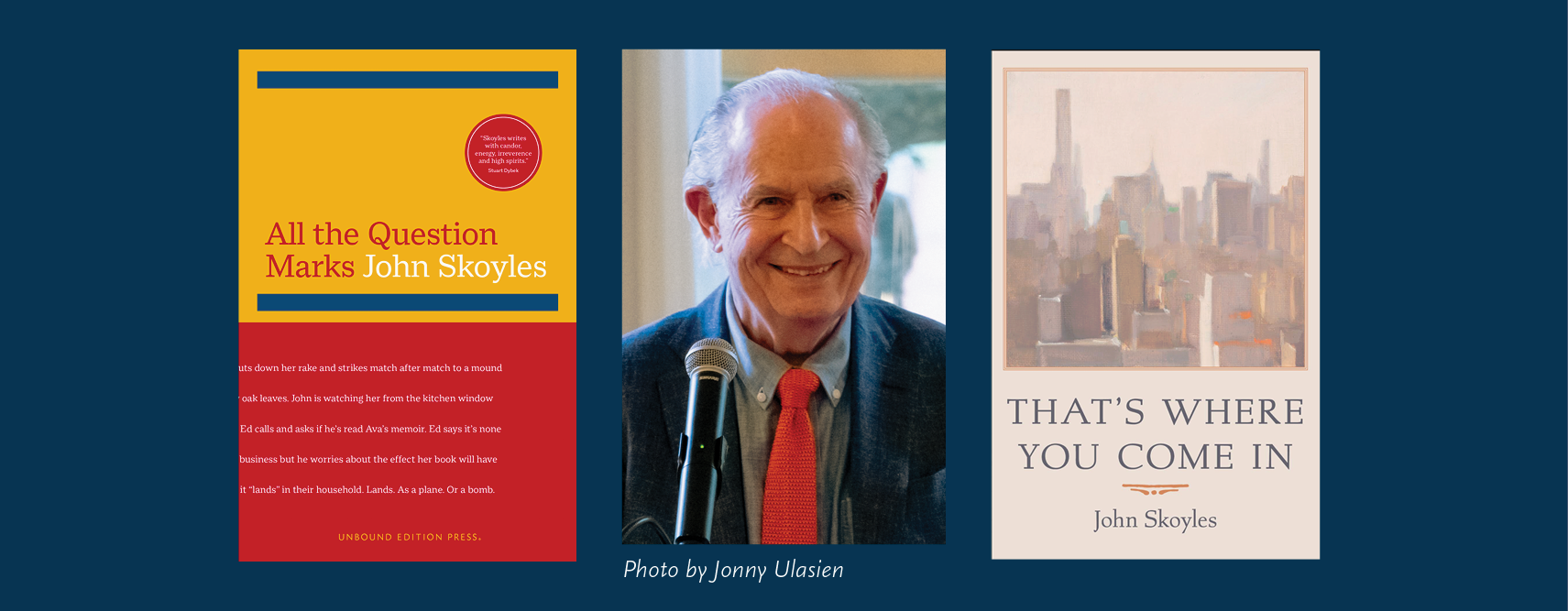
In this interview, Editor-in-Chief Jenny Molberg speaks with former Ploughshares Poetry Editor and Interim Editor-in-Chief John Skoyles about balancing editing and writing, championing emerging writers, and navigating the challenges of writing from personal experience. The conversation concludes with a reading of one of Skoyles’s poems.
Since 2007, John Skoyles served as Ploughshares’ Poetry Editor until February 2025, when he took over as Interim Editor-in-Chief before retiring later that year. During his tenure at the journal, Skoyles championed the work of emerging poets, celebrating enigmatic poetry that possessed, as he put it in his Editor’s Note for the Winter 2024-25 issue, “clarity and surprise.” Skoyles edited with great care and empathy, and continues his prolific career as a poet and writer.
Jenny Molberg: Hi, John!
John Skoyles: Hi, Jenny, how are you?
JM: I’m good; how are you?
JS: Very good. Thank you.
JM: Thank you so much for taking the time to sit down with me today. I’m just really excited to talk about your work, both as an editor and as a writer and poet. You served as poetry editor for Ploughshares for nearly 20 years. I believe it was 19 years.
JS: I think 18.
JM: And during that time you also published seven collections of poetry, as well as A Moveable Famine, an autobiographical novel, and you have more books on the way, which I’m very much looking forward to. You also taught for many years at Emerson College after having taught at other universities around the country, one of which we have in common, SMU, where my parents met.
I know from speaking to former students that you have made an indelible mark as a mentor. You served as an active member of the literary community, often reviewing books and publishing critical essays. In other words, you’ve worn many hats. Can you talk about how different approaches to literary work inform each other? Like, when editing might inform your writing, and maybe also what are the difficulties of switching from hat to hat, from top hat to Yankees ball cap to newsboy cap, etc.
JS: I love that question because I really hadn’t done much editing before DeWitt Henry asked me to be the Poetry Editor. I don’t know if you knew how that came about.
JM: I didn’t, no.
JS: Well, Don Lee took a job, and he’d been there forever [as Editor-in-chief], and done a terrific job with the magazine, and been a student at Emerson. But when he left, the President, Jackie Liebergott, asked DeWitt Henry, the founder of Ploughshares, to step in. So he did, and he asked Margot Livesey, who was on the fiction faculty, to be the Fiction Editor, and asked me to be the Poetry Editor.
So I really didn’t know what was involved in that, but I soon came to love it and to be humbled by the amount of good work that came over the transom all the time; in fact, one of the pleasures of it was sometimes people ask me who was in the magazine. I can’t actually name the poets, but I can name the poems, and I think that’s one of the things that distinguishes Ploughshares from the onset– I think, with the last issue I edited, the Winter 2024-25, almost half of the contributors had not published books. And they were fantastic. So, what I loved about editing was discovering new poets.
I wouldn’t have done that if not for the structure of the magazine, which was having the readers, the first-round readers, and then senior readers. Because the senior readers were, you know, 28-30 years old in the MFA program or beyond, or people who just applied to be readers who did a fantastic job passing on work to me that I wouldn’t have known.
So I felt it really fed my own work in that it made me familiar with presses I wouldn’t have known.
Ugly Duckling; Yes, Yes, presses like that that I wouldn’t have run into in bookstores, because you don’t see those in many places. So, for me, it was a great joy.
JM: You just said something that’s going to make me jump around a little bit, which is always kind of a fun thing. You mentioned how many writers and poets you published who hadn’t published a book yet. One thing that I admire so much about your work as an editor, and about Ploughshares in general, is just that the journal champions emerging writers. For you, I think, between your mentorship of the poets at Emerson in the MFA program, and beyond, but also in the journal. I wondered if you could talk about the history of the Emerging Writers’ Contest at Ploughshares, and also the importance of publishing emerging writers.
JS: I think that I learned very early the need for young writers to have support. And that came from my leaving Iowa when I was 23 with my MFA. I was going to the Fine Arts Work Center in Provincetown, which gave awards only to emerging writers. Then when I became director years later, I realized what a beautiful mission that was, and also how hard it was to fund that mission, because when you’re up against other organizations who can reel off the names of the writers and poets who are famed, who they support, it’s easier for those kinds of supporters to get behind known names.
But when you say, “Our job is to place bets on people you don’t know,” they shy away. But over the years at the Fine Arts Work Center, I mean, it’s produced, well, Louise Glück, Ann Patchett, Lucy Greeley, Michael Cunningham, Yusef Komunyakaa, Major Jackson, Jhumpa Lahiri. You couldn’t have a book when you applied. I think that’s still the case.
So that was dear to my heart because it meant the world to me. And also what it gave you was a chance to be among people all at the same level. We formed a really great community, which is still the case today.
I had come from Iowa, which had a real hierarchy in terms of the financial aid, which it doesn’t have anymore. I understand everybody’s funded there, which is just a wonderful thing, because in my time it was like they were teaching writing fellows and teaching assistants and research assistants, and then nothing. So it wasn’t good for anybody.
I was glad to learn of that change. It’s a make-or-break point, really, to support people when they come out of an MFA program or never even went to an MFA program, but are starting to publish work. I think I was always appreciative of what it gave me.
As an editor, I never read cover letters because I knew if I read the cover letter and it named all these famous journals, I might be inclined to say, this must be good, which is, you know, I mean, we both know, we all know there can be a bad note on a good piano.
JM: Right?
JS: So I always read the work and said, who’s this? I never heard of this person, but these are fantastic poems. So part of my mission as an editor came from what I received, I think, as a young poet from other quarters.
JM: It’s interesting…what the gifts you receive as a young person, and also sort of the gaps–what you find yourself missing as a young person–inform how you teach and edit, you know?
JS: Yes, that’s absolutely right. In other words, you do the opposite of what was not good for you.
JM: Yes, like there are some ways I learned how not to edit, right?
JS: I learned how not to teach.
JM: That too.
JS: Yeah, no, because they were so, you know, some teachers were very harsh or dismissive of work …I always appreciated the person who could find–if it was a bad poem–the one spot that you could expand on.
I know how much you love painting, and I always love this story about Franz Kline and de Kooning [Willem]. Kline was all over the place with his work, and he was showing it one time to de Kooning, and de Kooning pointed out in the corner; he said, “Look at this little black slash that we have here. I wonder what would happen if you magnify that…”[i]
JM: That’s his work.
JS: That’s his work, and I always love that as a teacher, too, because if someone saw that in you, and you had a pretty much of a mess of a poem, and they saw a couple of phrases, they say, you know, this might be the real thing here.
It’s funny because the other day, I was reading an interview with my close and now late friend Michael Burkard, in which he said that we had (I had forgotten about this), that we had gone to a reading of his together, and somebody asked him about poems he read in the book Ruby for Grief.
And he didn’t like the question the man asked him, which was, “Why aren’t your poems more open in other books as they are in that book?”
I had said to him afterward, “You know, I think he’s onto something. When you put more into a poem, it’s very, very interesting―as opposed to just leaving out.” And he said he realized that was true after his initial umbrage at the question. It was a breakthrough for him.
So friends and teachers and colleagues can impart growth to each other if they leave the competitive world behind, which is and has always been, I think, the way of the journal, and the way that I can see that you and I have felt as part of our pedagogy.
JM: Yeah, I think we share that. David Keplinger (who you published in the winter issue you edited, Winter ’24-25) was that teacher for me, that teacher who I just looked at and said, “That is how I want to teach, to be that, to live and breathe poetry and just to transmit that to my students, you know?”
JS: We’re lucky to have someone like that.
JM: So lucky.
JS: I was lucky to go to Provincetown because at Iowa at that time, I have to say that there wasn’t a lot of teaching going on. And then can you imagine going to a place where people were reading your poems without compensation? And Alan Dugan would write long letters on legal pages about my poems, you know, and we’d have conferences, and same with Stanley Kunitz and Grace Paley, who were doing it out of the goodness of their hearts. We’re lucky to have met people like that.
JM: Yeah, the legacy. It’s beautiful. I just mentioned this, but when Ladette Randolph retired, you stepped in as Interim Editor-in-chief, and then you also edited the Winter ’24-25 issue of the journal. I’m just curious if you could talk about what you’re particularly proud of in terms of your work at the journal.
JS: Oh, I don’t know how proud I am of it, but I am pleased with how it happened. I remember when she asked me to edit that issue, I was very nervous about it. Because I had seen so many of these great guest editors come through before. But I’ve decided, not knowing fiction the way Ladette did, that I had to rely on her for that. And she was great.
I approached the issue the way a developer starts a mall. I figured I’d need two big box stores– which I got, Joan Silber and Charlie Baxter. I said, “Do you have a story to lay the foundation for this issue?” Joan gave me “Mercy,” the title story of the book that came out the year before, and Charlie gave me that fantastic story “Ghost,” too. And then Ladette, you know, I have to say, all those other choices. She gave me a lot of stories, but she vetted all those.
I didn’t solicit any poets. I just took what came; I thought that was honest, you know, because I think the magazine has always been impartial to things like that. Once in a while, maybe you could see someone who you like has a book coming out, and you ask them to send some poems or something. But I didn’t do that with this. We got so much terrific work that it was hard to pare it down, in fact. And you know what I’m saying, because you have to turn away things, and a lot of them are…Well, as, as you know…I think it’s always comforting for young poets to know that sometimes it’s never a judgment on your work when you get rejected. It just means we didn’t have room for it or it didn’t fit the issue…it doesn’t mean it’s a bad piece. So, anyway, that’s the way I went about doing it, and then I had to write the introduction.
I had seen so many fantastic introductions, too. But I based the introduction on the exchange that I have almost weekly with Jonathan Aaron, who was my colleague at Emerson the whole time I was there–25 years–and even tonight, at 5:00, we’re going to discuss each other’s poems. So we wait for each other to write poems, and it’s really been a spur to me to keep going.
I mentioned in that introduction that the way that we exchanged poems was the way that I felt these poems were coming to me. I read them with the same care and the real joy of seeing what’s in the packet, you know. I love doing that. But it was a lot of work, I have to say. I realized the guest editorship is a ton of work.
I loved it, but you’re doing it all the time now. But you’ve done it for years, too. So you were more used to doing that than I was. It was a surprise to me.
JM: It’s a lot of work. I’ve taken your lead with no solicitations, I feel like, because we get so much incredible work that you’re not really expecting. And it’s hard to say no, because if we had 600 pages, I’d probably fill them. We just get so much work from great poets.
We are very excited to debut the inaugural John Skoyles Prize this coming fall, which honors a poem published in the journal from the last year. We’ll be announcing the winner in the fall longform issue, but I wondered if you could talk about what you feel like are the qualities of a prize-winning poem.
JS: Well, the qualities of a prize-winning poem are the qualities of any good poem, I guess. By the way, I have to say thank you very much for honoring me in this way, and I’m still in shock over it and very much humbled by it. So thank you for this great honor.
JM: Thank you.
JS: A poem is a verbal construct. As Wordsworth said, “Men speaking to men,” you know, or “language in orbit.” But I always think poems that I love are ones that jump right off the page. They speak to me right away. They also have a musical quality that is not overbearing, and they have a surface quality that might be a coupling of words which you hadn’t expected.
I used as my guideline for that issue I edited, “clarity and surprise.” I like those two things–although one of my first influences when I was a kid was John Ashbery, when he hadn’t published many books, maybe two, Some Trees and The Tennis Court Oath.
Whether you could say he’s clear or not is a matter of debate, yet I love his work. It might be the opposite of clarity in some cases, but I love the wit of his work. I love the abstract quality of it. Sometimes it’s imponderable, you know, you really can’t make it out. But, you know, the lines of his, like, “my head among the blazing phlox / Seemed a pale and gigantic fungus.”
“Portrait of J.A. and the Little Prospect of Flowers,” or something like that…[The Picture of Little J.A. in a Prospect of Flowers”]… I can’t remember the title, but I remember those lines.
So it’s clarity and surprise, but often I like it when a poem varies from that, too. So I don’t have any…strictures, you know, about what a poem should be.
I like poems that are lighthearted as well as poems that are emotionally moving. Ron Padgett, for instance, has a poem I used to use in a workshop. And on the first day, when I’d hand out a lot of poems I love, there was this one poem in which he just describes: he’s in his apartment, and he’s saying goodbye to his wife. And the last line is, she says, “write a poem for me when I’m away.”
And there’s the poem, you know, that’s it, you know, so I like that as I like both ends of the spectrum, you know–that and Auden, or Yeats, or Elizabeth Bishop, or, one of my favorites, Afaa Michael Weaver.
I remember, in 1996, he gave a reading at Emerson. Two poems struck me very deeply, and I asked him for copies, and he gave them to me. And then when I got the job as Poetry Editor, I wrote to him, and I had the two poems, which I love, and I said, “Did you ever publish these?”
And he said, “I have no recollection of these.” So I said, well, let’s have lunch. And I showed him the poems. He said, “My goodness, I didn’t have these.” It’s“Visit # 1”; in the Winter 2012-13 issue. It’s a very moving poem.
JM: Oh, I’ll look it up.
JS: It’s about visiting his son in prison with his father; the speaker and his father visiting the speaker’s son in prison. So I like a variety of poems, but mainly poems that have a verbal charge to them–no matter whether the heft is emotional in a deep way, or in a kind of subtle way, or even sometimes a silly way.
JM: You reminded me of something…B.H. Fairchild, who I was lucky enough to have as a teacher, used to say to me: “A great poem is never mysterious about clarity, but always clear about mystery.” That always rings in my head.
JS: Well, there’s a difference between mystery and mystification, something like sleight of hand. A true mystery…I think all poems, all great poems, you really can’t write a prose reduction of them. It’s a foolish task. Some poems sometimes try to hoodwink you with a sleight of hand, and I can see that, and I can see it in my own work. I’ll think, you know what’s wrong here, it’s this ending. I’ve seen this ending before in other poems, and I don’t like it. I’m going to cross that out. It was trying to be mysterious or something, but it actually was a non sequitur of the worst sort.
JM: That’s interesting because being an editor really does, if you get some distance from your own work, you can really kind of try to approach it with that eye and say like, wait a second, no, that’s, you’re being lazy.
JS: It’s true. Yeah, I know. It’s true. But sometimes I hope I don’t let anything particularly cheap go by. But sometimes I say I can’t get this any better.
JM: Yeah, me too.
I would love to spend some time talking about your own creative work, so when we had a poetry event at the St. Botolph Club here in Boston, and you read this marvelous poem, “The Beginning”. It’s a love poem, and it ends with the lines, “I tell you I’m starting to fall… / but you interrupt, saying Oh, / and this is the next to last line / and just the beginning.”
I just love the way the poem is aware of its own making, how it compares falling in love to the unraveling of lines, and I think you really capture the surprise that comes with…this is kind of a mystical thought, I guess, but with the arrival of a poem. So I wondered if you could talk about the challenges and the rewards of writing love poems.
JS: That’s a tough one…I was nervous about the ending of that poem, because it was so self-conscious…to mention that you’re writing a poem is nothing I really had done before, and I didn’t intend to.
JM: It’s hard to pull off.
JS: It just worked its way into that, and it was a surprise to me. I’m glad you liked it, because it was worrisome…It’s self-conscious, and it can fall on its face. Well, love poems–I always liked Frank O’Hara’s book called Love Poems (Tentative Title). Because that’s kind of what they are.
I learned a lot from reading love poems, from reading Cavafy’s love poems, for instance, “Half an Hour.” That’s one of the great ones of his. I’ve always loved them. Sometimes my language isn’t as heightened as I wish it would be, because maybe I have the subject too much in mind.
Cavafy’s poems are quite plain. I read some mean critic, and maybe it was one of his colleagues, who called his poems “pedestals without statues.”
JM: Oof! Yikes.
JS: That’s what I love about them, though. They’re so bare, and they’re so plain-spoken, but they’re heartfelt and beautifully written.
Love poems seem more born than made. They usually arrive with a line, and travel places that I never know, and sometimes end up about the writing of the poem. So that’s probably not much of an answer.
JM: Do you feel like a love poem might be different than other poems…I’m thinking of [Wordsworth’s] emotions recollected in tranquility. Is a love poem best when you’re in it, when you’re in love, versus maybe another poem where you really have to grapple with something like grief or something that needs more distance?
JS: Some love poems come because they’re poems of seduction. Because maybe you’re in love but you don’t know if the person you love is in love. You think, maybe if I write a really good love poem….
JM: I don’t think I’ve ever tried that!
JS: Oh, in the Plume that came out like two months ago or so, I have a poem called “Unrequited.” And then the editor, Danny Lawless, asked for a few sentences about each of the poems. I only wrote one sentence about that poem, which was: “If the poet’s affection had been returned, this poem would not have been written.”
JM: Ha! Enough said. That’s great.
Speaking of your new work, you have two books coming out this October. Hooray! I can’t wait to read them. Your autobiographical novel, All the Question Marks, and your newest book of poems, That’s Where You Come In. So can you talk about how you move as a writer between prose and poetry? When you write prose, do you start with an idea for a project? Do you ever write prose or start with prose, discover you’re writing a poem, or vice versa?
JS: No, usually the poems either come or they don’t. But I like having a prose project because I can work on it every day. I don’t know if you’ve ever been in an arts colony or writer’s colony, but when I was at Yaddo years ago, I remember my next-door neighbor was Malcolm Bradbury. I could hear his typewriter going–it would drive me crazy, because he was working all day, and I was sitting there, you know, fooling around with a few lines on a page, and I could hear him tossing off what I was imagining were novels after novel.
JM: His aggressive productivity!
JS: Maybe it was a tape loop…I could never write prose during the school year as a teacher, because it takes hours at your desk, and poems–not that they don’t take hours at your desk–but you change a sentence, you change a line, you put it away. You could reach diminishing returns… I can, myself, reach diminishing returns on a poem if I stick around it too long. I have to walk away; I have to show it to someone; I have to put it away for a week or whatever, so I have a few going at a time, but with prose I can knock it all out and then go back later. And it doesn’t come easily to me; I’m not a natural.
I remember hearing that David Remnick at the New Yorker could write a first draft–he would write 40,000 words in a week, or whatever it was–and hardly revise. My goodness. For me, I go over it and go over it and over it.
The reason that I began writing prose many years ago was that I was writing narrative poems, and at least for me, I couldn’t contain them in the line. So the lines stretched into sentences across the page. I needed a new genre. A lot of these poems were anecdotal, I have to say, looking back, to their detriment. They were in a minor key.
I think they needed to burst out into something else, so I think they were neither fish nor fowl at that point, but I called them poems. And so I was able to move into prose. I still chop up my long narratives into small sections. That’s the way I can handle it.
So that doesn’t come naturally to me. And even when you ask about the crossover…I mean, even the title for that novel, All the Question Marks, comes from Tomas Tranströmer’s line, “all the question marks began singing with God’s being” [from “C-Major”].
Anyway, that’s how I like to juggle them back and forth. And I wasn’t writing poems while I was working on this book, but every once in a while a poem would come, or a line would come, and it would, you know, give me something.
JM: I wondered if you could speak to the decision to publish autobiographical fiction versus memoir.
JS: Yeah, I find it hard to believe that there’s such a thing as nonfiction, actually. I mean, if you and I were to recount this story, of what happened today in this conversation, they’d be very different, but they’d both be true. We’re not liars. Intentionally, anyway.
I guess I don’t have the imagination like my fiction friends, to invent a whole character, and a whole situation and a whole plot in the story. So most of the things I write are autobiographical. And they’re all fiction at the same time. It might have the skeleton of my life, but the flesh is invention. And so, it’s really memoir that’s dressed up.
JM: I can think of several fiction writer friends whose stories or novels I’ve read where I think, well, isn’t that memoir? Didn’t that happen?
JS: And sometimes, when you read a novel, you can say, “This is Joe!”
JM: Exactly. Exactly.
JS: That’s why being with fiction writers is always dangerous. One of my close friends always says, if I tell her a story, she says, if you don’t use that in six months, it’s mine.
So that’s one thing. But the other is, you see this quirk that appears in some character and you go, wait a minute, did I really–isn’t that me?
JM: That might be true for all of us writers. I have to show you my mug. [The mug reads, “Be careful or you’ll end up in my book”].
JS: That’s exactly it! That’s it! That’s very funny!
JM: This is the perfect segue into my next question. I was reading about All the Question Marks. I read a description that said the protagonist confronts his wife’s memoir, and then there’s a shadow self that interrupts the narrative. I think that one thing that we don’t often talk about as writers, or maybe that I wish we talked more about, is how we are often personally involved with other writers, and we see ourselves show up in their work.
What do you think about writing about your personal life, all the potential ramifications or risks? How do you protect yourself and protect those you love? And that could be emotionally, that could be legally, that could be personally, but while also staying true to your own truth.
JS: When I came to Emerson, there was no memoir writing course. I was working on Secret Frequencies, and I knew the graduate students wanted that class because our personal essay class was overflowing. And memoir is, really, an extended personal essay. So I invented a course. As is the case with new preparations, I overdid the workload, and had students reading a memoir a week as well as writing a chapter a week. But to get to your question, I often had a student say about a project: I don’t want to say this about my mother.
And I overdid it, I remember, because I had them read a memoir a week–it was a 12-week semester then–plus handing in, you know, a chapter. It was too much, I learned. But, in many cases, the student would come and say, I don’t want to say this about my mother.
I remember I had a pat answer that I came to regret. Which was, “Well, do you want to be a good daughter, or a good writer?” I thought that was very clever, as a teacher. And then as years went by, I realized, well, that’s not as easy as it sounds.
Almost everybody I know who writes a memoir is afraid to give it to somebody.
JM: Yes.
JS: Right? I mean, because somebody might very well be hurt.
JS: I’ve been guilty of that, I think. Without malice. And someone asked me, how did that come about? Well, I said, you get so involved in these characters when you create them, and they might be based on different people. And then you expand their flaws or their characteristics that make them unique. And you get into that world so deeply that you forget…they become more real than the human beings you’ve based your work on.
And so, when you finish it, you’re very pleased with this world you’ve created, and the people you’ve created. And you’ve forgotten that there are people of flesh and blood who will read this and see themselves in it reflected in ways that are very painful.
In some ways, I regret that. So over the years, I took back that flippant remark that I made when I thought I was teaching them well–and I’m not saying that they shouldn’t pull punches when they’re writing, but there might be ways of disguising, or handling that in a more delicate way than reproducing the fact exactly as it happened.
JM: Yeah, the truth can hurt.
JS: And yet, even as I just said that, I’m thinking, well, you know, some very ugly things that can be memorable and perhaps make your book more effective. There’s no clear answer. I think you have to weigh it.
JM: We’re so excited to now have you as an Advisory Board member at Ploughshares, so I’m curious: What are you excited about the future–in terms of Ploughshares or literary publishing more widely– and what challenges do you anticipate in terms of literary publishing in the next few years?
JS: Oh my goodness, well, you know, the reason that the magazine has survived all these years–it’s very easy to put your finger on.
How many years is it now? 50?
JM: 55.
JS: And how many editors have there been?
JM: Four.
JS: Right, DeWitt, Don, Ladette, and you. So the continuity is fantastic; and yet the diversity is fantastic because of the guest editors. I mean, DeWitt invented a fantastic structure. So you always have somebody in place, and you do the two] issue[s] a year that the staff edits, and then you never know what you’re going to get when you open the magazine. And, you know, it’s Annie Finch. What is Annie Finch going to say? What does, you know, look back at Paul Muldoon, or, whoever is editing it. And it’s such a list of great guest editors.
JM: Incredible, yeah.
JS: So, that kept the magazine fresh and stable. I like that our magazine is printed. What I love about the physical book is, I write in the first pages, for example, “Page 12, a phrase, page 13, a phrase.” I know you can highlight this on the Kindle and they’re all there, but if you were to come over to my house, I’d say, “Oh, look at this book.” And I’d open it up, and it’d say, “Page 29, listen to this line.” So I like the physical book. I’m always worried places are going to go online, and it’s just not the same.
JM: Thank you for all these brilliant answers. It’s been a really fun conversation.
JS: A lot of fun. Thank you.
JM: Will you send us off with a poem?
JS: Yes, thank you for asking me. I picked this short poem called “Poem for a Summer Morning.”
The spider plant and Christmas cactus
don’t quite rejoice yet there’s an awakening
at the windows and walls from the rustle
of the garbage truck and overheard phone calls.
We who are left in the city don’t care
for the sea or shore at this time of day,
just let us play in the stray ups and downs
because someone has to be around to keep
the sweaty city surviving the news.
We’ve got nothing to lose except our losses
which subtract from the sum of voices,
faces, sirens and that glum cat on his sill
asking a question all cats ask which no one’s
answered yet except to say it’s another day.
JM: Thank you so much, John. I love your poems. I can’t wait for this book.
JS: Thank you, Jenny.
P.S. from Jenny: Since John and I first met in June 2025, we have had an ongoing conversation about our shared admiration for the mid-century American Abstract Expressionists. While sifting through notes I’d made on Elaine de Kooning’s life and work for my forthcoming poetry collection, I came across a passage in Mary Gabriel’s Ninth Street Women that sheds additional light on this anecdote. My research involves twentieth-century women artists and the ways they were often overshadowed by the male artists with whom they were romantically involved. Many women artists of this era—including Elaine de Kooning, Lee Krasner, and Ana Mendieta, among many others—worked in the shadows of domesticity, frequently promoting their husbands’ careers while their own work received less attention.
As John wrote to me in an email, he had heard this story about Franz Kline and Willem de Kooning long before Gabriel’s comprehensive history was published. He remarked, “What a sexist world this is.”
Here is Gabriel’s account of the incident, which took place in 1948:
“A person Elaine identified as a ‘friend’ asked Franz, ‘Do you have any of those little drawings in your pocket?’ Kline made sketches on telephone book pages, and his pockets often contained one or two of them. He handed over a drawing of an empty rocking chair, and it was placed on the projector. The effect was astonishing. Franz’s chair, Elaine said, ‘loomed in gigantic black strokes.’ Said artist Peter Agostini, ‘I think Franz had no idea of doing big black-and-whites until Elaine de Kooning suggested one day that [he] should blow up one of his drawings and see what it looked like. So when he saw what it looked like, she said, “Well, why don’t you do that?” (Mary Gabriel, Ninth Street Women [New York: Little, Brown and Company, 2017], 333).
I share this addendum to highlight the historical silencing of women artists. Elaine de Kooning—a remarkable painter, portraitist, and art critic—made invaluable contributions to the Abstract Expressionist movement, contributions that have too often been minimized or overlooked. For further reading, see Elaine de Kooning’s 1958 ARTnews article, “Two Americans in Action: Franz Kline and Mark Rothko.” –Jenny Molberg, August 2026
John Skoyles is the author of seven books of poems and five of prose. All the Question Marks, an autobiographical novel (Unbound Edition Press), and That’s Where You Come In, a book of poems (Carnegie Mellon University Press), are forthcoming in 2026. His work has appeared in The New Yorker, The New York Times, The American Poetry Review, The Atlantic, Harvard Review, and many other publications. His awards include two grants from the National Endowment for the Arts as well as fellowships from the New York and North Carolina Arts Councils. Skoyles is Professor Emeritus at Emerson College.
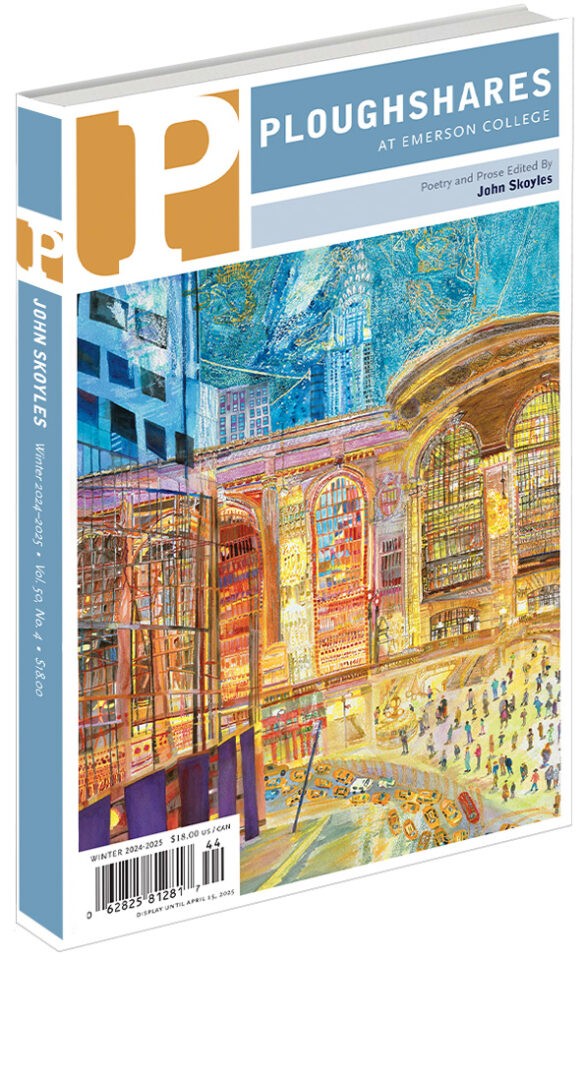
John Skoyles, Editor’s Introduction: Clarity and Surprise
John Skoyles, Snowfall, Against Autumn, Front Street
John Skoyles, Conviction