Lucille Clifton’s Electronic Archives
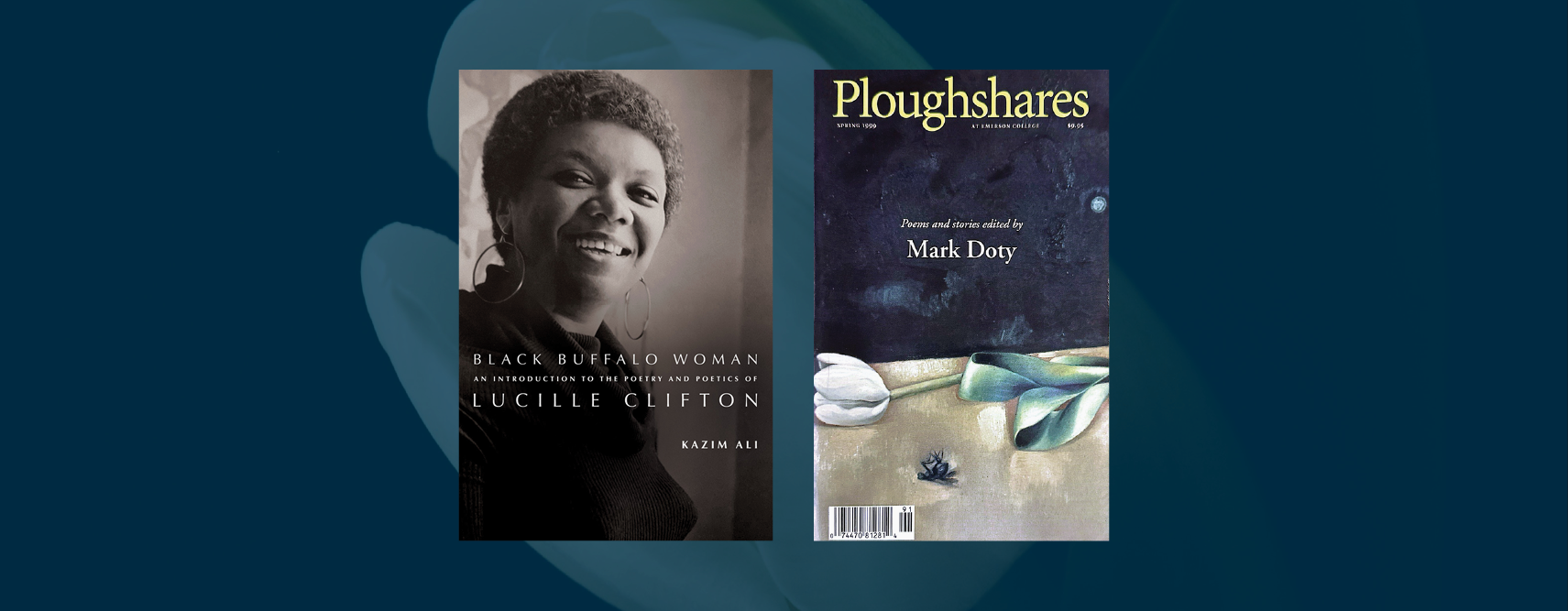
Kazim Ali is the author of Black Buffalo Woman: An Introduction to the Poetry & Poetics of Lucille Clifton, winner of the 2025 Pegasus Award for Poetry Criticism (Boa Editions, 2024). Of the book, Ada Limón writes, “There are few joys as authentic as witnessing one poet praise and honor another. Lucille Clifton is one such poet that deserves all the praise from those of us who attempt to wander in her wake. In Black Buffalo Woman, Kazim Ali allows for not only the elucidation of Clifton’s poems, but for their illumination. Each thoughtful essay lifts her poems to the light and returns you to Clifton’s brilliance and power.”
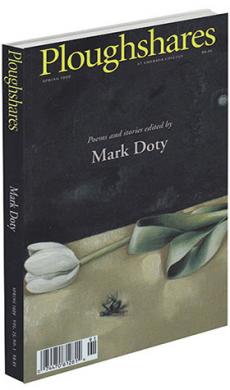
Ploughshares published Clifton’s poem, “Jasper, Texas, 1998” in the Spring 1999 issue, guest edited by Mark Doty.
Most of Clifton’s early work was composed on a manual typewriter. Something of the materiality of key striking a ribbon to make an impression on a page feels intrinsic to the sharp physicality of the poems themselves: condensed, powerful, present. I find a contemporary equivalent in the work of Tiff Dressen, a printer and poet, whose book Of Materials I selected for Nightboat Books, which was published in 2022. Someone who handles actual type, arranging the sorts into a forme for printing, knows how much labor goes into adding even a single word to a line. Clifton, though not a printer, shared that urge toward the stark, the sparse—which should not be confused with “minimal.”
Clifton, like many writers who are mothers with young children, has a gap in her publication history. After publishing nearly a book a year (sometimes more) between 1968 and 1980, Clifton published only one children’s book between 1980 and 1987. Other things happened in that time, to be sure: Fred Clifton ailed with cancer and then passed away, the Clifton family lost their house to foreclosure, and Lucille Clifton followed work west, away from Maryland, where the family had been living, to Santa Cruz, where the University of California had hired her to teach. Clifton wrote during that time but did not publish another collection until Next, in 1987, the same year that saw the publication of good woman: poems and a memoir, a book that collected her four volumes of poetry for adults, as well as her 1976 memoir generations.
As she continued writing, one significant change occurred: first, in 1987, Clifton switched to writing on a word processor, saving her files on diskettes (a very new technology at that time), rather than typing them out. The particular machine she used had a smaller screen, showing only a few lines at a time, but it was wider than the normal machine, showing around 100 characters per line as opposed to the average 75-80 words per line (this early model did not permit enlarging or reducing the font; nor, for that matter, did it allow a selection of font at all). Clifton used the machine for years, long into the era when most people were using laptops and desktop computers, though she eventually transitioned to using a desktop.
The first challenge for any archivist is to find the material at all. Since Clifton worked in various layers of technology—the typewriter, the word processor, a computer—and various media—hard copies, carbon copies, 3.5-inch diskettes, and finally poems either saved in a computer’s hard drive or in the bodies of emails sent to various people. It is such a small operation for a person to search through these electronic archives. There’s some irony in this process of discovery, in that the paper archives have their own sense of permanence but are much more easily lost than the endless files that lie hidden, coded on magnetic wire, inside hard plastic cases–less susceptible to disappearance, and yet as fragile in their own way: their existence across generations of media—some obsolete within a decade—means excavating the files and preparing them for public consumption could be as complex as unearthing papyri scrolls in the desert, though certainly not as physically arduous.
Clifton passed in 2010, and her archives were expeditiously made available to scholars and researchers by the managers of the collection at the Rose Library at Emory University. Michael Glaser, a longtime colleague of Clifton, along with poet and scholar Kevin Young, set about editing the Collected Poems of Lucille Clifton, which Clifton’s publisher, Boa Editions, released in 2012. This book included twenty-eight early poems that Clifton did not include in her first book, five other poems from the 1970s not included in books, and then thirty-five poems from the last four years of her life. Glaser and Young did not yet have access to the born-digital materials (so called because their original form was digital, as opposed to physical archives which are later digitized) from Clifton’s VisionWriter diskettes, nor her computer hard drives and email. They explain further, in their “Editors’ Note,” “We have not gathered here Clifton’s few occasional poems—with rare exceptions, sprinkled as “Uncollected Poems” throughout—nor any poems she published in magazines but left uncollected in book form during her lifetime.”[1]
That’s the second challenge for the archive diver (cormorants, Susan Howe called us): what should be included or not included? Glaser and Young also did not include any of Clifton’s writing for children. When I collected later unpublished work, I also found seven poems written as a short manuscript for an intended children’s book; upon consultation with Sidney Clifton—Lucille Clifton’s daughter, and the excellent and careful curator and director of her archive and estate—we felt these should be reserved for the purpose Clifton intended for them.
I went to Atlanta in the summer of 2023 to look at her physical archives in connection with the book I was then writing, Black Buffalo Woman: An Introduction to the Poetry and Poetics of Lucille Clifton. Neither Glaser and Young nor Aracelis Girmay, editor of Clifton’s posthumous selected poems, How to Carry Water, had yet had access to the born-digital materials. Clifton’s physical and born-digital archives are not available to researchers, except in physical presence at the Rose Library. Quite ingeniously, I feel, Kevin Young, who was then the Curator of Literary Collections at the Rose Library, made a decision to load Clifton’s digital files onto a laptop so that researchers could access all born-digital material then available, not in physical printed-out form, but in the original on-screen electronic format. As of this writing, there is still more material being processed.
What I discovered as I began looking through the files was that Lucille Clifton has working drafts of individual poems, as well as drafts for each of the collections she would go on to publish—Quilting, The Book of Light, The Terrible Stories, Blessing the Boats: New and Selected Poems, Mercy, and Voices. She was writing Quilting and The Book of Light nearly simultaneously, and at a certain point in time, she imagined they might come out in the same year, or one year after another. Each of these two collections went through radical shifts in contents that I chart in the “Notes” section of my edition of At the Gate: Uncollected Poems 1987-2010. In particular, she was quite particular in her intentions for The Book of Light. Nearly a third of the poems in the original draft manuscript bearing that name were not included in the final manuscript.
One of the poems from this time period tells of the Clifton family’s return to Maryland from California in 1989:
returning east
back to the ground
on which black blood
was spilled. here
a whip was taken to
my grandmere’s back,
or to her mother;
either way
there is an anguish
in this soil
i own. west,
the rocks are also scarred.
i recognize, but i return,
in this perhaps last gesture,
to walk among the tears
my mothers bled. [2]
Clifton longs to return to the place her own ancestors were enslaved. In generations, she recounts the tales of Caroline Donald and Lucy Sale, her great-great-grandmother and her great-grandmother respectively. While I am not sure which ancestor she is referring to as her “grandmere” (my gut is that it refers to Lucy Sale; the grandmother whose story is told in generations, Georgia Hatcher, is not enslaved, nor are gallicisms common in Clifton’s work otherwise), Clifton feels a bond with the land on which her women forebears suffered—were lashed and spilled their blood. The “scarring” of the Western landscape—whose ruin she also recognizes—does not belong to her the same way that the mid-Atlantic spaces of Maryland and Virginia still do.
Beyond offering glimpses into alternate trajectories in Clifton’s work, as in the above poem, one also sees the shape of longer and more famous works of Clifton. For example, there is a much earlier, and more erotic, version of “from the Book of David,” which appeared in her 1996 volume The Terrible Stories, much of which she seems to have written during a visiting semester at the University of Memphis. Clifton, ever attuned to resonances of language with history, found the city’s name on the major continental river quite meaningful as an echo of the ancient Egyptian city on the Nile.
In the archives, there was a folder named “Memphis,” and within it were several poem drafts, including the working version of “from the Book of David,” but interestingly none of the poems that Clifton did include in The Terrible Stories from this same time period, in a section she called “A Term in Memphis.” That section includes many famous and powerful Clifton poems which assuredly bear the mark of being composed by the stand-in Nile in the Memphis-that-is-and-isn’t-Memphis, including “slaveships,” “auction street,” and “the mississippi river empties into the gulf.”
The earlier version of “from the Book of David” is in a different order and privileges the personal and romantic relationships with Jonathan and Michal, the son and daughter of Saul, the King of Israel. Clifton’s later version paints a darker, more vengeful (and regretful) portrait of David than this original version. Michal is less important in the story, and Jonathan is mentioned not at all.
The final pattern that emerged from looking at these later poems is that Clifton only very rarely fully abandoned a poem. She continued to work on poems for a long time; some of the poems in the digital born files include lines or even full stanzas from unpublished poems from the 1960s and 1970s. She also formed and reformed books with laser focus. Her last two titles, in particular, Mercy and Voices, are both comprised of poems written closer to the time when she published the books, and poems from much earlier writing periods. Mercy includes a twenty-four-page sequence from the early 1970s and Voices includes a twelve-page sequence from the late 1980s.
This fact solved, for me, the third dilemma of the archive cormorant: would the writer have wanted this material published? Not only did I think deeply about her plans and intentions, but I had others to talk to about it—not only Sidney Clifton, who knew her wishes better than anyone, but also Peter Conners, a long time editor and now publisher at Boa, Richard Foerster, the book designer who worked on many of Clifton’s books, and others including professors Marina Magloire and Sumita Chakraborty, both of whom are writing critical and academic studies on various aspects of Clifton’s work.
To work in a writer’s archives is a humbling practice; one is never one’s own self—as is most common for one to imagine one’s life as a poet or other kind of creative artist—but rather, one is in community here, an attendant, an audient, an acolyte.
[1] The Collected Poems of Lucille Clifton 1965–2010, ed. Kevin Young and Michael S. Glaser (Rochester, NY: Boa Editions, 2012), xxvii.
[2] Lucille Clifton, At the Gate: Uncollected Poems 1987–2010, ed. Kazim Ali (Rochester, NY: Boa Editions, 2026), 30.
Kazim Ali‘s newest book of poetry is The Man in 119. He received the Pegasus Award for Poetry Criticism for his book Black Buffalo Woman: An Introduction to the Poetry and Poetics of Lucille Clifton. He is the founder of Nightboat Books, and currently a professor of comparative literature and literary arts at the University of California, San Diego.