A Conversation with Kelli Russell Agodon
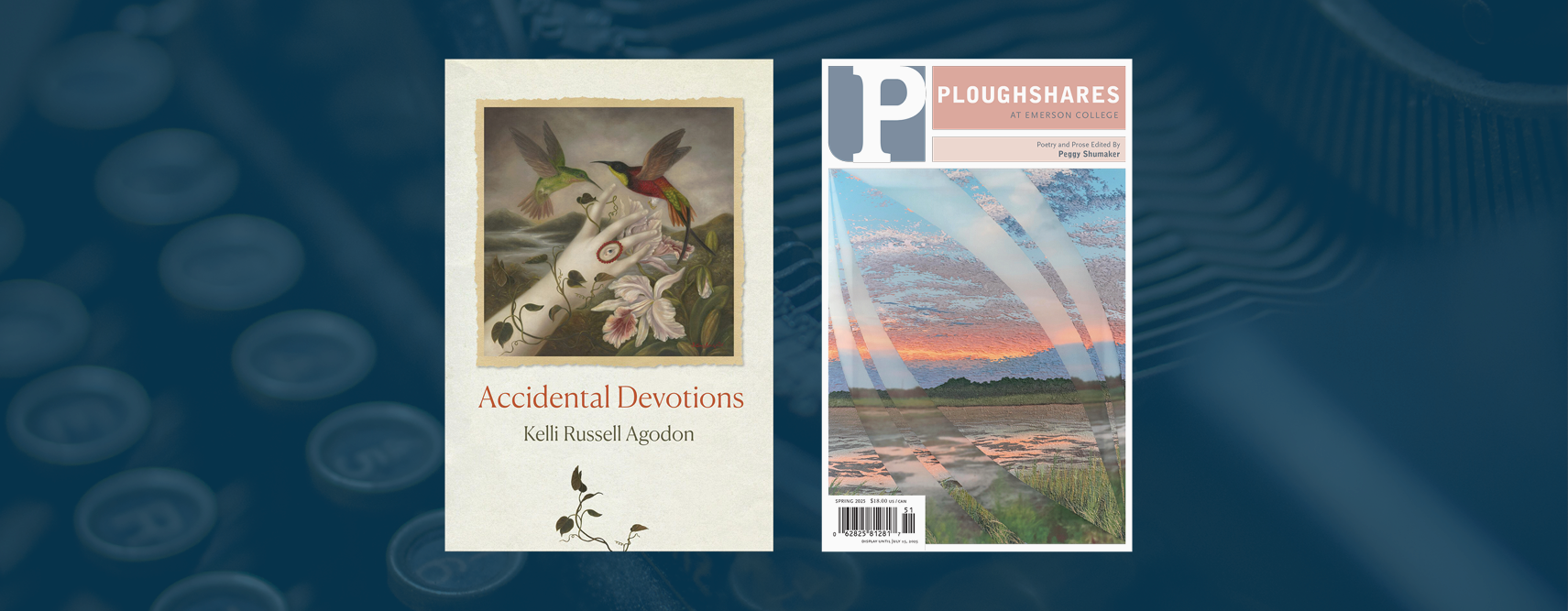
For her wild, leaping, surreal imagination, and her startling, unique metaphors, Kelli Russell Agodon has long been one of my favorite poets. Reading her new book, Accidental Devotions, I sometimes felt like I’d entered a dreamscape that has its own rules. For me, one big part of the joy in reading Agodon’s work is learning those rules, navigating that dreamscape. Here, I had the pleasure of traversing these extraordinary and peculiar worlds with Agodon as my guide.
–Melissa Studdard
Melissa Studdard: Let’s start with the oxymoron stamped across your cover—the title Accidental Devotions. It feels like a life philosophy, an ars poetica, and an introduction to your zany humor all at once, in just two words.
Kelli Russell Agodon: I love that you noticed the title is an oxymoron. Life feels like an oxymoron some days—a beautiful mess—and maybe poetry is my quiet rebellion. I was thinking a lot about where our attention goes and how those places become our devotions—desire, scrolling, poetry, grief, the fear of losing what we love—often without our permission or without realizing it. I think a lot about how I spend my time, as it’s our most precious resource, and for each of us, limited. I’m always thinking how strange it is that we live our lives not knowing if we get fifty years or seventy or a hundred or much less.
MS: So the poems stumbled into reverence without meaning to?
KRA: Yes—there was a point I realized I was treating my phone like a minor god, bowing to that small glowing screen throughout the day and it bothered me, but it also made me ask myself, “What else am I (are we) devoted to?” Initially, I didn’t sit down intending to write Accidental Devotions; I sat down trying to understand how to live. Or how to live better than I was. Maybe the reverence arrived through attention, my attention to the ordinary, to desire, to technology, even Emily Dickinson.
MS: I like that—a poem as a way of thinking about how to live better, and I also like thinking about your Emily Dickinson allusions as attention to, or a desire for presence.
KRA: I’ve always felt a connection to the dead and the past, and definitely ghosts. I collect old typewriters, so maybe that says something about my relationship with history. I’m drawn to objects and voices that have already lived a life before reaching me. Sometimes I feel as if I’m from the wrong century, dropped into a world of iPhones while I’m over here turning on an old radio and listening to swing music.
MS: So, this is why your Emily Dickinson poems feel more like summoning than referencing. I think of your lines “This is modern life and the Victorian era / happening at once. This is technology and yes-even-if-you—/ have-a-good-cell-plan-people-die vibrating my ass.”
So much of our time is lived online these days, yet so many of us still haven’t expanded our idea of what’s poetic to include cell phones and Twitter hashtags and sexting. These are all very much a part of your poems, though, and very naturally intermingle with fountain pens and typewriters.
KRA: Yes, like tuning into a frequency. Dickinson’s poems and letters are still transmitting something. In that sense, maybe dead poets become a kind of backup team. They’re there when I’m stuck, when I’m lonely on the page, when I’m trying to figure out how to keep going.
And I think with this book I was allowing everything in—nothing was “too precious.” Hashtags? Bring ‘em. Tweets becoming epigraphs? Done! Sexting? Bring it on! We live in a modern day, and while I continually press back against technology and try to live a mid-90s lifestyle (less connection, less screen time, more paper books), I realize how much of these gadgets occupy my day.
I also think technology carries an enormous emotional charge because it’s where so many intimate moments happen now—we learn about a friend’s death on Facebook, misunderstand or flirt with someone over text, watch those three dots appear and then disappear, receive a news alert about another ongoing tragedy. Even our experience of nature is mediated by it. A poet may be standing in a field listening to birds, but there’s probably a smartphone in their pocket, and maybe they’re photographing a cloud or opening the Merlin app to identify a warbler. Technology isn’t separate from our emotional or imaginative lives anymore; it has changed the way we grieve, desire, pay attention, and move through the world, so for me, it belongs in my poems.
MS: True, true! And what you said about being lonely on the page is so real. And we’re there for the dead poets too, aren’t we—as readers, admirers, and descendants? I’m thinking of “Hey Kel, It’s Em, I Called Because I Read Your Poem.”
KRA: I love that you’re thinking about a reciprocal relationship—poetry can feel like a conversation across time and, well, reality! While this poem began in a much more ordinary place: my own failure to return phone calls to my sister Emilie—Em—who leaves these wonderfully persistent voicemails: Hey Kel, it’s Em, call me back. It’s a reminder of how being readers ourselves can keep us engaged in the larger literary conversation. I had been reading Open Me Carefully: Emily Dickinson’s Intimate Letters to Susan Huntington Dickinson and thinking a lot about how I already “communicate” with the dead through their work. So the poem became a kind of mixtape of Em and Emily—my sister’s actual voice braided with Dickinson’s epistolary one. But I love that the poem lets that impossible question linger—What if Emily Dickinson did call? I think poetry lives in that kind of permission—the willingness to believe, to live in the disbelief, in that imaginative place—I mean, that’s how my mind works. It’s always asking, “What if? What else can happen?”
MS: Imagined events and multiple people conflated into individual characters—these are techniques traditionally considered the domain of fiction, but poets use them too, right? I mean, the “truth” that we look for in poetry is not a literal truth. It’s more the truth of dream logic—how, in a dream, the two Emilys collapse into one Emily so your mind can understand some truth that neither Emily would convey alone.
Of course, the difference between dreaming and making poetry is that the poet is also using the conscious mind to make decisions. I would love to know more about how you balance making decisions with being pulled along or guided by something subconscious.
KRA: Melissa, that is such a smart question because I think that’s how my poems exist for me, in two spaces—the creation and the revision. In the creation, I am not worried one bit about making sense, if I’ve brought in too many things, if I’m all over the place or too focused on one thing—all I am trying to do is to write a poem, play with language, and amuse myself. In this part, I am *not* thinking about the reader, only writing the poem.
When I get to revision, which is the second part of every poem for me, I’m very interested in what I’ve said and the clarity of my words. I think about the reader and what (if anything) they would take away from this draft. This is where I make those decisions you ask about. Many times, I leave poems in my “New Poems” folder for quite a bit of time, so when I pull them up, they may also feel “new” to me. This is where I read the poem to find typos, patterns, and themes, but there have also been many times I’ve read my own poem and thought, “WHAT AM I TALKING ABOUT?!”
This is the place where I have to decide 1) if the poem moves forward to be a “real poem” or 2) if this was just a “practice poem” that will live in the purgatory of my “New Poems” folder. The key—and it’s a large skeleton key—here is: I must revise in a way that doesn’t kill that initial energy that sparked the poem. That’s the challenge for me in any poem.
When I revise, I don’t want to blow out the fire and build a new fire; I want to enhance that fire, add a few logs here and there, take out some of the ash and give it more air, add a little extra kindling, move things around to create more heat. This is how I see the poem—as a blaze I want to turn into a beautiful bonfire. Which is funny because people always ask, “What sparked that poem?” which is both metaphorical and figurative, I guess!
This is how I see the poem—as a blaze I want to turn into a beautiful bonfire.
Kelli Russell Agodon
MS: Oh oh! Please say more about the “New Poems” folder and how you make decisions about what gets to be a real poem.
KRA: I’m kind of laughing at myself for calling it a “real poem,” as if I’m poet Geppetto wishing my Pinocchio would finally become a real boy. But yeah, the “New Poems” folder is where everything goes—every draft, every weird attempt, even if it’s just a title or a couple lines; I save it all. Once I’m ready to revise, I search “gp” (for “Good Poem,” which I will sometimes put in the file title when I save a draft I want to return to) in that folder and open like 10 to 20 drafts, which is honestly a lot.
From there, I go through and start reading the poems to see if anything sparks for me. If I read a poem and I’m not feeling it, I just close the document. I do this until I come to a poem I think could be more (a possible “real boy” poem!). Once I have a poem that I’m interested in, I start revising it. Usually that keeps me busy for a while, but if I hit a wall or get stuck, I just go to the next poem.
Oh! And one thing that’s very important that I do, which I learned from Ellen Bass, is that I copy the poem and paste it below the poem I’m working on, so I can always return to previous drafts. I never used to do this, but Ellen kindly told me to stop overwriting old drafts. So I did; now I can see various versions.
MS: Remind me to send Ellen a personal thank you. It’s so easy to accidentally edit out the energy of a poem, and I love this safeguard! So, in addition to saving drafts, how else do you avoid editing the energy out of your poems?
KRA: Uh, not well. I constantly edit the energy out of my work. I think some questions I’ve learned to ask myself are: Why are you overediting this piece? Is there something you’re afraid of, or something you feel self-conscious about? Does what you wrote make you feel vulnerable? Sometimes overediting is really an attempt to make the poem safer. Or maybe tidier (respectable?), especially when the original draft has said something a little wilder. For me, I’ll start innocently—replacing strange language with something more “poetic” and less weird. Or maybe I’ll explain what doesn’t need to be explained (or say it several more times in different ways!) I’ve learned that a lot of times, smoothing out the awkwardness takes away the spark as that may actually be where the life is. So I think that’s how I do my best to avoid it—I try to notice when revision is strengthening the poem and when it’s simply helping me hide from it.
MS: I feel like you do an excellent job of not editing out the energy, and one of the things I love most about your work is exactly that wild, raw energy, and the risk-taking that flames out from your process, to use your metaphor. This is all fully ablaze in Accidental Devotions, and I’d love to hear about some of the risks you took in the collection, particularly as they pertain to hope and joy.
KRA: That’s a wonderful question because sometimes being happy in dark times can feel like a risk. How can you be joyful when a), b), and c) are going on? So while this book still has my love of ghosts and darker things, it also includes much more hope and joy. I mean, Rilke gives life advice through an Ouija board; the speaker finally “passes” a mental health test; desire is everywhere, along with a lot of queer spirituality—hence Dickinson!
I think the risk was letting the hope (the thing with feathers!) stay, while allowing the poems to be on the wild side. I didn’t want to sand down my strangeness or make the joy behave. I wanted the poems to feel like they could hold contradiction, to say: yes, grief is here but also kissing in a cemetery; yes, a friend’s funeral but also a cellphone is vibrating in a back pocket. Life is this, that, and everything all at once, all the time—that’s my experience over the last decade.
I also took some other risks. The last poem is printed on a perforated page—something the reader can actually tear out—which felt interactive to me. Poetry book as collaboration with reader. And because of that final page and the artwork that comes before it, the book kind of has two endings. I wanted the book to end with God in a convertible, but I also wanted that final poem as a gift to the reader. Why do we only get one way to leave something once? What if there was a way to linger, to participate?
I guess there is also a kind of risk in not choosing one lane—in letting the poem be both séance and love letter, both confession and side-eye, both ache and almost-dance. I believe I trusted the reader more this time—to follow the leaps, to sit in the and/also of it, to not need everything explained or resolved, which might be another way of saying I trusted myself more, too.
MS: You mentioned queer spirituality a minute ago, and this seems to me your queerest book yet—almost a coming out. Tell us more about that.
KRA: Yes, this is probably my queerest book, though people have told me for years that my poems have “bi vibes,” which they certainly did. So if this book is a coming out, let’s just say the closet may have been made of glass—ha!
But I do think there’s something different about this collection. I’m much more upfront about desire, queerness, and the body. I could jokingly blame Jeannine Hall Gailey, who said to me on a writing retreat when I was working on this collection, “More sexy poems!”—honestly, maybe I should get this on a T-shirt or an embroidered pillow. But yeah, desire was already on my mind. I think I was just finally ready to let it walk into the room and sit down.
So while queerness is more openly named in this book, it’s also more embodied. In my earlier work, I think it was present, but I wasn’t always ready to move fully toward it on the page. This book gave me permission, or maybe I finally gave myself permission to let that part of the work be visible, complicated, funny, desiring, and fully alive.
And like many women, I think I’ve become more myself as I’ve gotten older. There’s a beautiful uncaring that comes with that, a freedom from trying to manage everyone else’s comfort. My younger self worried more about what people would think or what I was allowed to say. This book feels less interested in being allowed—it just opens the door and lets its whole self in.
And that connects to spirituality for me because I’m interested in devotion outside the official rooms. My spirituality can hold desire, doubt, grief, humor, the body, the beloved, the phone, Emily Dickinson, the ridiculous, and the holy all at once. Queerness has taught me to trust multiplicity, to distrust tidy little boxes, and to believe the self is not one thing, so maybe a poem shouldn’t be either.
MS: Speaking of little boxes, so many of your poems focus on giving advice or instructions, sometimes about poetry, and sometimes about life in general. I had some laugh-out-loud moments when I noticed you poking fun at yourself for giving, following, or not following instructions. The first poem in the book, “Advice”, has the line, “When in doubt—add plums to your poem,” and then, like an obedient third grader with instructions from your teacher, you proceed, hilariously, to plant plums through the pages of Accidental Devotions. And then there’s the one hilarious poem a little later, “Prompts,” that ends with the line, “Don’t begin /the poem with an instruction.” Tell us more about the role of these modes in your poems. So, first, where does the advice about plums come from, and second, tell us more about the roles of advice, prompts, and instructions in both your process and as subject matter in the poems themselves.
KRA: The advice about the plums came from my weird imagination. I was thinking, what would be the most absurd advice someone could give a poet? And I thought of William Carlos Williams and “This Is Just to Say,” with that famous delicious plum. It made me laugh to imagine someone taking the completely wrong lesson from that poem: Well, clearly what made it great were the plums—add plums to everything!
And because I had made that ridiculous rule, I decided it would be funny to obey it. So I planted plums throughout the book like little poetic Easter eggs. Thank you for noticing!
Advice, prompts, and instructions show up in my poems because it feels so much like my Capricorn life. I teach and have a million and one opinions; I write prompts for Two Sylvias Weekly Muse Substack; I make rules for myself, then resist them or follow them badly—sometimes I break them on purpose. And I’m fascinated by my human wish for instructions. In the poem, I think the instructions are both sincere and absurd because that also feels true to life. I mean, I want someone to hand me a map, but sometimes we’re trying to get back to Washington State, and someone hands me a map of Washington, D.C.—good intentions, but missing the mark. Which is maybe a way to say: advice can often be wrong, but not necessarily useless. And maybe we’ll all get where we’re going anyway.
MS: Amen to getting where we’re going anyway—that feels almost like a clever definition for poetry.
KRA: Yes, if we allow our words and the poems to steer us, maybe we’ll all meet up along the way. Or maybe poetry is the street that will take us to where we need to be.
Kelli Russell Agodon (she/her) is a bi/queer poet, editor, and book cover designer. She is the author of five collections of poems, including her newest, Accidental Devotions (Copper Canyon Press). She co-edited Demystifying the Manuscript: Essays and Interviews on Creating a Book of Poems with Susan Rich. She is the cofounder of Two Sylvias Press and co-hosts the poetry series Poems You Need with Melissa Studdard. An avid paddleboarder, Kelli lives in a sleepy seaside community in Washington State where she collects typewriters and keeps company with ghosts. www.agodon.com
Melissa Studdard writes poetry, song cycles, and libretti and is currently working on Covering My Father’s Face, a collection of poems about grief, love, and the strange ways we continue to communicate with those we’ve lost. Her most recent collection, Dear Selection Committee, includes poems featured by The New York Times, The Penn Review Poetry Prize, the Academy of American Poets, the Best American Poetry website, and the Poetry Society of America. As a librettist/lyricist, she has had works commissioned by Aspen Music Festival, the Philadelphia Chamber Music Society, Yale University Glee Club & Yale Choral Artists, and more. With Kelli Russell Agodon, she co-hosts the YouTube poetry series Poems You Need.